The Evolution of Religion

I’ve been attending the Language as Social Coordination: An Evolutionary Perspective conference in Warsaw, Poland.  I heard a talk by Konrad Talmont-Kaminski on the Evolution of Religion.  Although there have been many approaches to this before (and he has a blog on related themes here), his talk was particularly clear.

First, he drew a distinction between the co-ordination of action between a group of people and the co-ordination of long-term goals.  For co-ordination of action (e.g. carrying a heavy load/ sharing food), the discourse must reflect reality.  However, for co-ordination of goals, this need not be the case.  He gave an example of a hunt.  Talking about where to go and plans for herding or trapping should try to reflect the real problem as closely as possible.  However, if the hunt becomes long and arduous, some members might give up.  Invoking a wrathful god that might motivate people to continue.

In this sense, long-term co-ordination needs to sole the free-rider problem (where a lazy minority who still reap the benefits of the group will eventually destabilise the group and the benefits disappear).  You can do this by invoking beliefs in higher powers that punish defectors or reward co-operators.  However, evidence against these beliefs might destabilise the group.

The evidence against a belief can come in three forms:  Evidence can directly contradict the content of a belief.  A belief that there is a Unicorn that follows me around will soon be destabilised.  The answer is to make the beliefs invisible, dangerous of far away (the Flying Spaggetti Monster comes to mind).

A belief can also exploit the current methodological context.  For example, it’s easy to claim the shroud of Turin really does date back to the time of Christ if Carbon Dating hasn’t been invented yet.

Finally, a belief can use social context to protect it from destabilisation – for example, you can make the shroud of Turin ‘sacred’ so that it can’t be examined or questioned.

A belief that harnesses all three of these tactics is, in Talmont-Kaminski’s terms, ‘Superempirical’.  That is, you can’t disprove it because it resists empirical investigation. This means that religion can be shaped by functionality rather than evidence.  This is exactly what you want to achieve social co-ordination of long-term goals.

Talmont-Kaminski also points out that the consequences of defecting should also be Superempirical.  For example, going to Heaven or Hell in an afterlife.

In the conference, a commentator pointed out that many nations that have very good co-ordination of social goals (e.g. Sweden) seem to be aethist, while many nations that are very un-coordinated (e.g. Afghanistan) are rife with religious belief.  Talmont-Kaminski took this point, but argued that there are now social constructs (banks, government) that can take over the role of co-ordination of goals more effectively.

Talmont-Kaminski has a book coming out soon, a preview chapter can be found here.

Konrad Talmont-Kaminski (2008). In a Mirror, Darkly: Does Superstition Reflect Rationality? Skeptical Inquirer, 32 (4)
Bleg: Why CULTURAL Evolution?

That is to ask: Why has there been so much interest in cultural evolution in the last two decades or so? It seems to me that a lot of this thinking is just messing around, seeing if evolutionary ideas can somehow be attached to cultural phenomena in a coherent way. It seems more motivated by a desire to extend evolutionary thinking than by a desire to understand culture. And it’s not obvious to me that anyone has actually explained anything in this process, not so far.

In particular, has anyone used some theory of cultural evolution to explain some phenomenon of culture as well as, and ideally, better than competing non-evolutionary accounts? It’s not at all obvious to me that the answer to that question is “Yes.”

Note that I don’t exempt my own efforts from this criticism, which is why, on the whole, I’ve devoted more time to examining and analyzing cultural phenomenon than I have conceptualizing cultural evolution. In particular, I’ve spent a lot of time thinking about popular music in America, and the interaction of African-derived and European-derived styles (see, e.g. this longish paper) and, more recently, I’ve been looking at graffiti, which I’ll address later on.

Evolution?

One caveat: A lot depends on just what one means by cultural evolution. If one is just using ‘evolution’ as a substitute for ‘change,’ then the question has little meaning. It seems to me that much of memetics is like this, with the added innovation of attributing agency to the memes, rather than to people.

And then there’s gene-cultural coevolution (GCCE). Those folks may well have succeeded in coming up with useful explanations, e.g. lactose tolerance. But it’s not at all clear to me that GCCE can work with the kinds of phenomena that most interest me and that do constitute a great deal of cultural activity. As I’ve explained here, it’s not clear to me that GCCE has anything to say, for example, about something like the growth of graffiti in the last 40 years.

Graffiti 1

By ‘graffiti’ I don’t mean any writing on walls, but the specific practice that originated on the East Coast of the USA in Philadelphia and New York City in the late 1960s and early 1970s. The practice seems to have been pretty much confined to those cities by the early 1980s. But it had gone world-wide by the start of the current millennium. How did that happen? And why?

I don’t see that GCCE has any tools to answer that question. The spread is too fast for any biological changes to have been involved. Whatever’s going on has been going on purely within the cultural sphere. There are obvious things to point to concerning how it happened: 1) Press coverage of early graffiti made the activity more visible. 2) When graffiti became associated with hip-hop, it followed hip-hop in its spread through world pop culture. 3) Photography, books, and films (Style Wars, Wild Style) spread the word. 4) The emergence of the world-wide-web created a new means by which photos of graffiti could made instantly available around the world.

But none of that explains why the practice spread. What made graffiti so attractive to so many people in so many different places around the world? And why has it been, on the whole, so conservative, so that the themes and motifs that originated in the East Coast of the USA in the late 1970s and early 1980s are showing up in Japan in then 2000s? On one level that question answers itself. If the designs changed rapidly, so that putting any old design up on the walls counted as graffiti, then the activity would loose its identity, its genealogical connection with those first writers in New York City and Philadelphia. It would just be painting on walls, illegally. Big deal.

The genealogical connection IS important. Why? Note that, while stylistic conservatism maintains that identity, we also have to allow for the identity of individual writers within the tradtion. The tradition has to have enough internal variety to allow for that.

There are ways of talking about those questions, and you’ll find some of them in the literature, but the question I’m asking is this: Can a strong theory of cultural evolution do a better job of accounting for this spread than any other theory? If so, what would that theory look like?

Continue reading “Bleg: Why CULTURAL Evolution?”

A history of evolution pt. 2: The Wealth of Nations, Populations and On the Origin

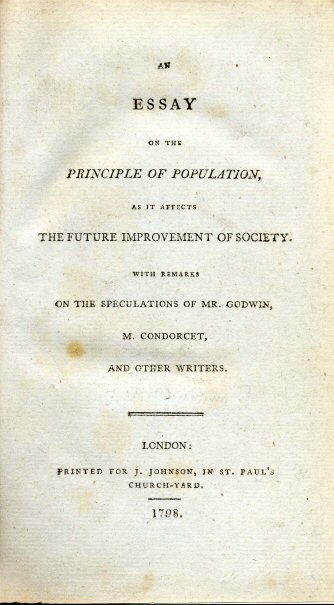
Title page of the original edition of Malthus' 1798 work

Continue reading “A history of evolution pt. 2: The Wealth of Nations, Populations and On the Origin”

Some Links #18: GxExC

The depression map: genes, culture, serotonin, and a side of pathogens. Another new science blog network (Wired) and once again a new stable of good science writers. I’m particularly pleased to see that David Dobbs, a former SciBling and top science writer, has found a new home for Neuron Culture. I was also pleased to see he had written an article on studies into the interactions between genes and culture, namely: Chiao & Blizinsky (2009) and Way & Lieberman (2010). And I was even more pleased to see that he’d mentioned both mine and Sean’s posts on the social sensitivity hypothesis. Suffice to say, I was pleased.

Take home paragraph:

In a sense, these studies are looking not at gene-x-environment interactions, or GxE, but at genes x (immediate) environment x culture — GxExC. The third variable can make all the difference. Gene-by-environment studies over the last 20 years have contributed enormously to our understanding of mood and behavior. Without them we would not have studies, like these led by Chiao and Way and Kim, that suggest broader and deeper dimensions to what makes us struggle, thrive, or just act differently in different situations. GxE is clearly important. But when we leave out variations in culture, we risk profoundly misunderstanding how these genes — and the people who carry them — actually operate in the big wide world.
Razib also has some thoughts on the topic:
The same issues are not as operative when it comes to culture. Two tribes can speak different dialects or languages. If a woman moves from one tribe to another her children don’t necessarily speak a mixture of languages, rather, they may speak the language of their fathers. The nature of cultural inheritance is more flexible, and so allows for the persistence of more heritable variation at different levels of organization. Differences of religion, language, dress, and values, can be very strong between two groups who have long lived near each other and may be genetically similar.

Homo was born vocalizing. Babel’s Dawn links to a recently finished PhD thesis that supposedly argues for a relatively recent emergence for language (approx. 120,000 years ago). She defends her assertions by stating: “[…] all of the unique cognitive traits attributed to humans arose as the consequence of one crucial mutation, which radically altered the architecture of the ancestral primate brain.” I haven’t read the thesis, and I probably won’t as I’m already stretched in regards to my reading, but I’m completely unconvinced by the hopeful mutation hypothesis. Plus, as Bolles notes in his post, there is plenty of available evidence to the contrary.

Primed for Reading. Robert Boyd reviews Stanislas Dehane’s new book, Reading in the Brain: The Science and Evolution of a Human Invention, which I’ll be picking up soon. In the meantime, to give you a bit of background, I suggest you read Dehane’s (2007) paper on the Neuronal Recycling Hypothesis: the Cultural recycling of cortical maps. H/T: Gene Expression.

Through the looking glass (part 1). The Lousy Linguist reviews Guy Deutscher’s new book, Through the Language Glass: Why the World Looks Different in Other Languages, with the general takeaway message being that, in part one at least, one where the book is a bit science-lite. What really interested me, though, were these two paragraphs:

We discover quite quickly what Deutscher is doing as he begins to walk through complexity issues of “particular areas of language” (page 109), namely morphology, phonology, and subordination. And these last 15 pages are really the gem of Part 1. He shows that there is an interesting, somewhat illogical, entirely engaging but as yet unexplained set of correlations between speaker population size and linguistic complexity.

For example, languages with small numbers of speakers tend to have more morphologically rich grammars (hence one could claim that small = more complex). However, small languages with small numbers of speakers also tend to have small phonological inventories. Hmmm, weird, right? [My emphasis]

As those of you who read this blog will know: I don’t think it’s weird that small speaker populations also tend to have small phonological inventories.

Clothing lice out of Africa. A cool new paper by Troups et al which looks at the evolutionary history of clothing lice to provide specific estimates on the origin of clothing. Using a Bayesian coalescent modelling approach, they estimate that clothing lice diverged from head louse ancestors between 83,000 and 170,000 years ago. H/T: Dienekes.

Language, Thought and Space (III): Frames of Reference in Language and Cognition

In the second chapter of his 2003 book Space in Language and Cognition: Explorations in Cognitive Diversity, Stephen Levinson discusses a concept that has been crucial to discussions of space and ‘perspectivation’ in language: frames of reference. (see e.g. these posts on my blog Shared Symbolic Storage) The term as it is used today was coined by Gestalt theorists of perception in the 1920s and was used to signify the steady and constant background against which other objects could be made out and identified. It can be defined as
“‘a unit or organization of units that collectively serve to identify a coordinate system with respect to which certain properties of objects, including the phenomenal self, are gauged’ (Rock 1992: 404, emphasis in Levinson 2003: 24).

Language and Complexity: Evolution Inside Out

Here is a video of Terrence Deacon, someone who needs no introduction on this website, giving a talk at Irving K. Barber Learning Centre about his latest research into language evolution:

Continue reading “Language and Complexity: Evolution Inside Out”

Where does the myth of a gene for things like intelligence come from?

As a linguist I struggle with genetics, I am, however, as an evolution geek, very interested in it. This creates all sorts of problems and high levels of anxiety when talking about FOXP2 and other genes, due to fear that I misunderstand the very highly complex interactions which exist between genes, environmental effects or cascading effects which cannot be summed up in a simple “x gene causes x trait in humans” paradigm.

I would like to point everyone towards a new blog Dorothy Bishop’s written over at guardian science blogs:

Where does the myth of a gene for things like intelligence come from?

Which is about busting the widespread belief (for idiots like me) that individual genes determine traits such as intelligence, optimism, obesity and dyslexia. I find it interesting that this is presented in the blogs section and not as a mainstream article.

She points out on Twitter this morning that the Jedward pic was not her idea. (I add this point because I found it weirdly comforting)

And it’s also lovely to see that at the bottom of the pile of comments is a well articulated reply by Dorothy to individual users.

I love blogging, because there exists  the ability for individuals to reply to claims made about them, primary sources (papers &c.) are cited and checkable and there’s none of the unnecessary dumbing down found in mainstream media. Here’s an article by Ben Goldacre expanding on this subject (which incidentally includes work by Dorothy Bishop).

Here is a parable about how, as a blogger, my claims were checked, discussed and ultimately concluded to be bollocks. (I don’t have a contrastive parable about what would have happened if I’d instead made these claims in the mainstream media but many stories of this nature can be found here.)

If you read the blog post I wrote about links between Autism and SLI you would have seen me make this claim:

the CNTNAP2 gene has been found in independent samples to be associated with both ASD and SLI. This is interesting because it could show that gene mutations which cause improved social abilities could have also caused changes in our linguistic ability on a syntactic or phonological level.

This blog post cited the work of Dorothy Bishop quite heavily and she took the time out to come and tell me problems with it. Here’s what she said:

As you anticipated, I think there are some problems with the implications you draw from the work. There are two issues. The first is that the variants of CNTNAP2 associated with language level are not mutations. You would usually only use that term in the case where most people had the same DNA sequence in a gene, but rare individuals had a different DNA sequence. FOXP2 is a case in point: there is a family, the KE family, who have a mutation affecting around half the family members, where the DNA sequence is changed. For most people in the general population, and for most people with SLI, the FOXP2 sequence is the same.

The CNTNAP gene is very different. The DNA sequence has different versions in different people, and one version, which is pretty common in the general population, is associated with a small decrease in language abilities, but most people with this version would not be recognised as having any language impairment. Most researchers now think that SLI is probably the result of the combined effect of many genes, each of which may nudge language ability up or down a bit. In this regard, language ability is rather like height: there are rare mutations that may make a person drastically tall or short, but most variation in height arises from combined effect of many small influences of genes that show DNA variation in the normal population.

The second issue concerns the evidence for CNTNAP2 being involved in both SLI and autism. Many people in the field do think this means that the same gene that can cause SLI can also cause autism, and that the only difference is that people with autism have additional difficulties going beyond language – what I have termed the ‘autism as SLI plus’ model. I supported that model in the past, but there are some facts that are hard to square with it. First, although many people with autism have structural language problems (affecting grammar and phonology) similar to those in SLI, not all of them do. So people with high-functioning autism or Asperger syndrome may have well-developed skills in syntax and phonology, while still having difficulties with pragmatics. The second point, which is a big problem for a simple genetic account, is that whereas the relatives of people with SLI often have some difficulties with structural language, we don’t usually see that in relatives of people with autism, even if the person with autism has poor language skills. It was this latter point that I was particularly keen to try and explain in my paper. The bottom line is that to explain the pattern of data we need to think in terms of interactions between genes (technically known as epistasis). So there are genetic variants that increase risk of autism, and others that increase risk of SLI. Most of these will have an individually small effect. However, if you have a risk variant for a gene influencing SLI (such as CNTNAP2) in the context of having a genetic risk for autism, the effect on language will be much worse. According to this model CNTNAP2 doesn’t affect both social cognition and language; rather it affects language, but that effect will get multiplied if the person also has risk factors for autism.

Which is SOOOO interesting.

I’d really like to thank her for replying, it’s really lovely to know that high-flying academics are willing to help out when a sincere blogger tries to understand something and falls on their arse.

Memetic Sophistry

Over at the Psychology Today blog complex, Joseph Carroll is taking Norman Holland to task on remarks that Holland made concerning the relationship between the reader of a literary text and the text itself. Though I disagree with Carroll on many matters, I agree with him on this one particular issue. Beyond that, I think his critique of Holland can also be applied to Susan Blackmore’s equivocations on memes. Here’s what Carroll says about Holland:

This whole way of thinking is a form of scholastic sophistry, useless and sterile. It produces verbal arguments that consist only in fabricated and unnecessary confusions, confusions like that which you produce as your conclusion in the passage you cited from your book: “the reader constructs everything” (p. 176). This conclusion seems plausible because it slyly blends two separate meanings of the word “constructs.” One meaning is that our brains assemble percepts into mental images. That meaning is correct. The other meaning is that our brains assemble percepts that are not radically constrained by the signals produced in the book. That meaning is incorrect. Once you have this kind of ambiguity at work for you, you can shuffle back and forth between the two meanings, sometimes suggesting the quite radical notion that books don’t “impose” any constraints—any meanings—on readers; and sometimes retreating into the safety of the correct meaning: that our brains assemble percepts.

Blackmore equivocates in a similar fashion on the question of whether or not memes are active agents. Here’s a snippet from a TED talk she gave last year:

The way to think about memes, though, is to think, why do they spread? They’re selfish information, they get copied if they can. But some of them will be copied because they’re good, or true, or useful, or beautiful. Some of them will be copied even though they’re not. Some, it’s quite hard to tell why.

Here she talks of memes as though they are agents of some kind, they’re selfish and they try to get copied. A bit later she says:

So think of it this way. Imagine a world full of brains and far more memes than can possibly find homes. The memes are trying to get copied, trying, in inverted commas, i.e., that’s the shorthand for, if they can get copied they will. They’re using you and me as their propagating copying machinery, and we are the meme machines.

Here memes are using us as machines for propagating themselves. And then we have this passage where she talks about a war between memes and genes:

So you get an arms race between the genes which are trying to get the humans to have small economical brains and not waste their time copying all this stuff, and the memes themselves, like the sounds that people made and copied – in other words, what turned out to be language – competing to get the brains to get bigger and bigger. So the big brain on this theory of driven by the memes.

The term “meme,” as we know, was coined by Richard Dawkins, who is also responsible for anthropomorphizing genes as selfish agents in biological evolution. Dawkins knows perfectly well that genes aren’t agents, and is quite capable of explicating that selfishness in terms that eliminate the anthropomorphism, which is but a useful shorthand, albeit a shorthand that has caused a great deal of mischief.

Continue reading “Memetic Sophistry”

More on The Social Sensitivity Hypothesis

This post was chosen as an Editor's Selection for ResearchBlogging.orgIn a recent post, James wrote about the Social Sensitivity hypothesis.  Given findings that certain genetic variants will make a person more sensitive to social contact and more reliant on social contact under stress, it proposes that certain genetic variants ‘fit’ better with certain social structures.  In support of this idea, Way and Lieberman (2010) find a correlation between the prevalence of this variant and the level of collectivism (as opposed to individualism) in a society.

An alternative explanation I’ve been thinking about is migration patterns.  If genetic differences make a person less reliant on social networks, they may be more likely to migrate.  This would predict that areas settled later in human history will have more ‘non socially sensitive’ individuals.

Continue reading “More on The Social Sensitivity Hypothesis”

A Replicated Word Cloud

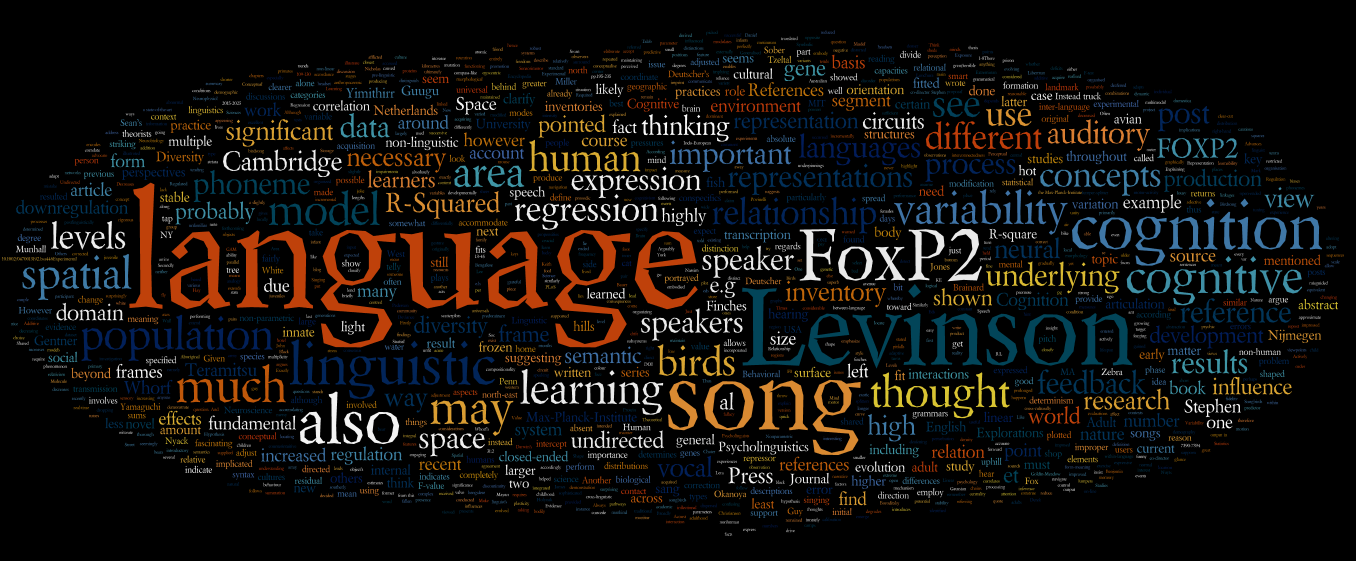
I found this cool website for generating really awesome looking word clouds: http://www.wordle.net/. Here is a word cloud for this website:

Apparently, the clouds are based on word frequency, but I don’t think it can be pulling much data from this website if Levinson is coming out as one of the most frequently used words. Still, it entertained me for a few minutes. H/T: Glossographia.