Matt Ridley’s contractual silence

This morning I just received my copy of Matt Ridley’s latest book, The Rational Optimist: How prosperity evolves. I must admit that, despite being a big fan of Ridley’s writings, I found myself somewhat disillusioned since his role in the subprime mortgage crisis at Northern Rock. In particular, I was always confused as to why Ridley never defended himself against scathing attacks from the likes of George Monbiot. Maybe it was an admission of guilt? Perhaps. But I now have a somewhat more satisfying explanation for the silence:

I am writing in times of unprecedented economic pessimism. The world banking system has lurched to the brink of collapse; an enormous bubble of debt has burst; world trade has contracted; unemployment is rising sharply all around the world as output falls. The immediate future looks bleak indeed, and some governments are planning further enormous public debt expansions that could hurt the next generation’s ability to prosper. To my intense regret I played a part in one phase of this disaster as non-executive chairman of Northern Rock, one of many banks that ran short of liquidity during the crisis. This is not a book about that experience (under terms of my employment there I am not at liberty to write about it). [my emphasis].

So there you have it: a contractual obligation to keep schtum. It’s a shame, really, as I would hate to be in a position where I am not even given the opportunity to defend my position, especially on a topic that generated a massive amount of news and speculation.

As for the book: so far, so good. It’s also a lot larger than I expected. I do have some minor quibbles, but they can wait until I write a more thorough review.

Futurama Supports Cultural Evolution

A recent episode of Futurama – ‘A clockwork Origin‘ – sees the Professor go head to head with Creationists, and makes a good point about the difference between Creationism and Evolution.

After his work on the origin of man is mocked, the Professor decides to leave Earth for a desolate planet. However, the nano-bots which he designs to purify the water evolve overnight into a full-scale ecosystem, complete with robo-dinosaurs that are eventually wiped out by a solar flare.

At first, the Professor is unwilling to see the change in the robots as Evolution, saying ‘Those robots didn’t evolve by themselves, I put them there – I’m a genius, get over it’. However, after the crew is captured by robo-anthropologists (anthrobopologists?), he’s forced to admit that they really have Evolved. Further, he’s forced to admit that he has no problem with the idea of a creator playing a small part in the origins of Humans, just as he started the race of robots.

This is all good news for those studying Cultural Evolution – people are coming round to the idea that Evolution is an abstract process rather than the theory of how humans evolved from apes.  Perhaps us researchers will be spared in the robot uprising, which is sure to come:  As Bender says “Robots do everything faster, including evolving”.

Some quick announcements

Just thought I’d make three quick announcements:

First, I decided to drag myself into the age of 140-characters and (albeit begrudgingly) joined Twitter. I say begrudgingly because my day is already packed with plenty of distractions besides adding Twitter into the mix… But I noticed it’s the place where all the cool science bloggers are gathering, and gradually coagulating into an amorphous cloud of science networking, so I thought I might as well sign up (ever the follower, never the trendsetter).

Second, if you happen to find yourself in Edinburgh on Friday October 1st, then you can come and see me and Sean presenting our respective posters (click here and here for the abstracts) at the 24th Language at Edinburgh Lunch. I’m sure, for me at least, it’ll be quite a sobering experience in highlighting how little I know about phonology, phonetics, sociolinguistics and demography. On the plus side I’ll get some free food 🙂 .

Lastly, if you happened to click on my poster abstract, then the more observant of you will have noticed I’m now affiliated with Cardiff University. Yes, that’s right, I’m doing yet another masters course. This time it’s at the Centre for Language and Communication Research, with the idea being that I’ll get a more solid foundation in research methodology etc before pursuing a PhD or research assistant position.

That is all.

New Language and Genetics department

Next week, on the 1st October, there will be a new language and genetics department opening at the Max Planck Institute, the first research department in the world entirely devoted to understanding the relationship between language and genes!!!

This excites me so I wanted to share the news.

This statement is from Simon Fisher, who will head the new department about what they will be trying to achieve:

‘We aim to uncover the DNA variations which ultimately affect different facets of our communicative abilities, not only in children with language-related disorders but also in the general population, and even through to people with exceptional linguistic skills’, says L&G director Simon Fisher. ‘Our work attempts to bridge the gaps between genes, brains, speech and language, by integrating molecular findings with data from other levels of analysis, particularly cell biology and neuro-imaging. In addition, we hope to trace the evolutionary history and worldwide diversity of the key genes, which may shed new light on language origins.’

More signs of the growing and diversifying field of language evolution!

Here’s a link to the news on the MPI website: http://www.mpi.nl/news/new-mpi-department-language-genetics

Language, Thought, and Space (V): Comparing Different Species

ResearchBlogging.org As I’ve talked about in my last posts (see I, II, III, and IV) different cultures employ different coordinate systems or Frames of References (FoR) when talking about space.  FoRs

“serve to specify the directional relationships between objects in space, in reference to a shared referential anchor” (Haun et al. 2006: 17568)

As shown in my last post these linguistic differences seem to reflect certain cognitive differences:

Whether speakers mainly use a relative, ego-based FoR, a cardinal-direction/or landmark-based absolute FoR, or an object-based, intrinsic based FoR, also influences how they solve and conceptualise spatial tasks.

In my last post I also posed the question whether there is a cognitive “default setting” that we and the other great apes inherited from our last common ancestor that is only later overridden by cultural factors. The  crucial question then is which Frame of Reference might be the default one.

Continue reading “Language, Thought, and Space (V): Comparing Different Species”

Alcohol Consumption affects Morphological Complexity

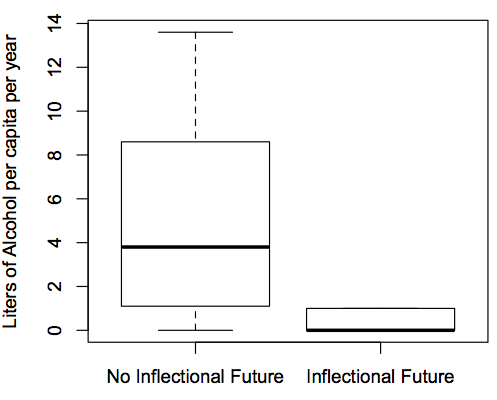
I previously talked about how changes in the demography of learners can affect the cultural evolution of a language.  The hypothesis is that language adapts to the balance between declarative and procedural memory users.  Since alcohol consumption affects procedural but not declarative memory (Smith & Smith, 2003), we might expect to see communities that have a high alcohol consumption using less complex morphology.

I find that communities that have a morphologically marked future tense have significantly higher alcohol consumption than communities that have a lexically marked future tense (Alcohol consumption data from WHO, language structure data from World atlas of language structures, 198 languages, t = 14.8, p<0.0001).  This statistic does not take into account many factors, but is meant as a motivation for further research into language structure and social structure.

Smith C, & Smith D (2003). Ingestion of ethanol just prior to sleep onset impairs memory for procedural but not declarative tasks. Sleep, 26 (2), 185-91 PMID: 12683478

Language Log and The Future of Science Blogging

Last night I head a talk by Geoffrey Pullum about the linguistics mega-blog language log.  Amusing as always, Pullum introduced us to the writers and took us through some of his favourite posts.  We even got to see a post being published live!  I shouldn’t have to tell this audience about language log, but I did learn a few new things – did you know that Mark Liberman sometimes gets up at 4am to write posts?  Did you know Pullum has written his own computer program for keeping track of what he’s said?

Recently, I was talking to a mathematician about blogging and he revealed that most research in mathematics is presented, reviewed, criticised, corrected and incorporated before the journal article reaches print.  Publishing is more about prestige while the actual research has bypassed the review process.  David Dobbs writes this week about the inflated importance of paper publishing and argues that mediums like blogging are faster, cheaper and engage the public – which should be a priority for science.

I asked Pullum whether he thought blogs would take a similar role in Linguistics.  I was expecting a reply about the self-evident nature of mathematics and how Linguistics is a subject where you really need a peer-review and editorial process.  However, Pullum was very positive about the role of blogs in research, and pointed out that many theories undergo rigorous criticism on language log, sometimes within minutes of being posted.  Further, he feels that the blog has had an effect on science journalism and that people are much more cautious about putting forward the kinds of views that Language Log takes apart (Snowclones, prescriptive grammar etc.).  Pullum also feels that blogging requires more bravery than peer-reviewed publishing:  Your idea is open to the wide world without careful consideration by many people.

Certainly, I’ve benefited from blogging about my research.  On the one hand, it forces me to put my research in a clear, concise format.  On the other hand, other people do some of the work for me by asking questions, pointing out problems and even, in one case, checking the validity of my data.  There’s even talk of blogging being part of assessed coursework for the MSc course here.  Maybe one day, there will be no more need for the mysterious art of printing research on paper.

Genetic Anchoring, Tone and Stable Characteristics of Language

In 2007, Dan Dediu and Bob Ladd published a paper claiming there was a non-spurious link between the non-derived alleles of ASPM and Microcephalin and tonal languages. The key idea emerging from this research is one where certain alleles may bias language acquisition or processing, subsequently shaping the development of a language within a population of learners. Therefore, investigating potential correlations between genetic markers and typological features may open up new avenues of thinking in linguistics, particularly in our understanding of the complex levels at which genetic and cognitive biases operate. Specifically, Dediu & Ladd refer to three necessary components underlying the proposed genetic influence on linguistic tone:

[…] from interindividual genetic differences to differences in brain structure and function, from these differences in brain structure and function to interindividual differences in language-related capacities, and, finally, to typological differences between languages.”

That the genetic makeup of a population can indirectly influence the trajectory of language change differs from previous hypotheses into genetics and linguistics. First, it is distinct from attempts to correlate genetic features of populations with language families (e.g. Cavalli-Sforza et al., 1994). And second, it differs from Pinker and Bloom’s (1990) assertions of genetic underpinnings leading to a language-specific cognitive module. Furthermore, the authors do not argue that languages act as a selective pressure on ASPM and Microcephalin, rather this bias is a selectively neutral byproduct. Since then, there have been numerous studies covering these alleles, with the initial claims (Evans et al., 2004) for positive selection being under dispute (Fuli Yu et al., 2007), as well as any claims for a direct relationship between dyslexia, specific language impairment, working memory, IQ, and head-size (Bates et al., 2008).

A new paper by Dediu (2010) delves further into this potential relationship between ASPM/MCPH1 and linguistic tone, by suggesting this typological feature is genetically anchored to the aforementioned alleles. Generally speaking, cultural and linguistic processes will proceed on shorter timescales when compared to genetic change; however, in tandem with other recent studies (see my post on Greenhill et al., 2010), some typological features might be more consistently stable than others. Reasons for this stability are broad and varied. For instance, word-use within a population is a good indicator of predicting rates of lexical evolution (Pagel et al., 2007). Genetic aspects, then, may also be a stabilising factor, with Dediu claiming linguistic tone is one such instance:

From a purely linguistic point of view, tone is just another aspect of language, and there is no a priori linguistic reason to expect that it would be very stable. However, if linguistic tone is indeed under genetic biasing, then it is expected that its dynamics would tend to correlate with that of the biasing genes. This, in turn, would result in tone being more resistant to ‘regular’ language change and more stable than other linguistic features.

Continue reading “Genetic Anchoring, Tone and Stable Characteristics of Language”

Memory, Social Structure and Language: Why Siestas affect Morphological Complexity

Children are better than adults at learning second languages.  Children find it easy, can do it implicitly and achieve a native-like competence.  However, as we get older we find learning a new language difficult, we need explicit teaching and find some aspects difficult to master such as grammar and pronunciation.  What is the reason for this?  The foremost theories suggest it is linked to memory constraints (Paradis, 2004; Ullman, 2005).  Children find it easy to incorporate knowledge into procedural memory – memory that encodes procedures and motor skills and has been linked to grammar, morphology and pronunciation.  Procedural memory atrophies in adults, but they develop good declarative memory – memory that stores facts and is used for retrieving lexical items.  This seems to explain the difference between adults and children in second language learning.  However, this is a proximate explanation.  What about the ultimate explanation about why languages are like this?

Continue reading “Memory, Social Structure and Language: Why Siestas affect Morphological Complexity”

Language, Thought, and Space (IV): Comparing Different Cultures

In my last post on the relationship between language, thought and (thinking and talking about) space I wrote that one of the most interesting, but also one of the most difficult questions is to what extent linguistic differences in talking about space reflect conceptual and perceptual differences.
Researchers at the Max-Planck-Institute for Psycholinguistics (Nijmegen, Netherlands) and at the Max-Planck-Institute for Evolutionary Anthropology (Leipzig, Germany) have done very interesting experiments that shed light on this question
As I mentioned in a previous posts (see here) work done by Stephen Levinson and others on how different cultures talk about and conceptualize space has shown that not all of them employ a bodily, egocentric frame of reference or coordinate system as their dominant organizing principle for their experiences and thoughts. Speakers of “several indigenous languages of Australia, Papua New Guinea, Mexico, Nepal, and south West Africa,” in contrast, organize the axes of their dominant coordinate system by absolute principles such as fixed landmarks (e.g. uphill vs. downhill) or cardinal directions (e.g. move the chair to the north). In addition, there are also langouages that primarily use “intrinsic,” object-centred Frames of Reference, such as in “The dog is at the front of the library.”
Differences between Relative and Absolute Speakers in Non-linguistic Spatial Tasks
In a set of clever experiments Levinson and his colleagues have also shown that speakers of relative and absolute languages differ in how they solve non-linguistic spatial tasks.