Theory of Mind and Language Evolution; What can psychopathology tell us?

Theory of Mind is the ability to infer other persons’ mental states and emotions. It is thought to have evolved as part of the human’s social brain and probably emerged as an adaptive response to increasingly complex primate social interaction.

Brüne and Brüne-Cohrs (2006) explore the ‘evolutionary cost’ of language evolution:

This sophisticated ‘metacognitive’ ability comes at an evolutionary cost, reflected in a broad spectrum of psychopathological conditions. Extensive research into autistic spectrum disorders has revealed that theory of mind may be selectively impaired, leaving other cognitive faculties intact. Recent studies have shown that observed deficits in theory of mind task performance are part of a broad range of symptoms in schizophrenia, bipolar affective disorder, some forms of dementia, ‘psychopathy’ and in other psychiatric disorders.

Now it’s fairly uncontroversial to assert that without the ability of theory of mind humans would have never evolved language (Sperber and Wilson, 2002). This is due to the fact that if one can’t attribute another to have a ‘mind’ like ones own, or assume that other minds hold different information to ones own then one would see little point in trying to share information. (I’m sorry for the amount of ‘ones’ in that sentence).

Sooo, it does not seem presumptuous to assume that people interested in the evolution of language should be interested in theory of mind, in fact for many years evolutionary linguists, psychologists and biologists have been looking into this, but mostly through observing the behaviour of animals, and especially primates to see if they display theory of mind capabilities. A good summary of this work can be found here, and a lot of relevant studies can be found on this blog in the What makes humans unique? posts by Michael. I’m not going to look at the animal data in this post, but instead what the deficiencies in some human conditions can tell us about the evolution of theory of mind. That is, what can autism, schizophrenia, bipolar affective disorder, dementia, ‘psychopathy’ and other psychiatric disorders tell us?

Continue reading “Theory of Mind and Language Evolution; What can psychopathology tell us?”

Evolution of Colour Terms: 6 Categorisation Constraints

Continuing my series on the Evolution of Colour terms, this post reviews evidence for categorisation constraints on colour perception. For the full dissertation and for references, go here.

Continue reading “Evolution of Colour Terms: 6 Categorisation Constraints”

Evolution of Colour Terms: 5 Cultural Constraints

Continuing my series on the Evolution of Colour terms, this post reviews studies of cultural constraints on colour naming. For the full dissertation and for references, go here.

Continue reading “Evolution of Colour Terms: 5 Cultural Constraints”

Massive Science Blogging Aggregator

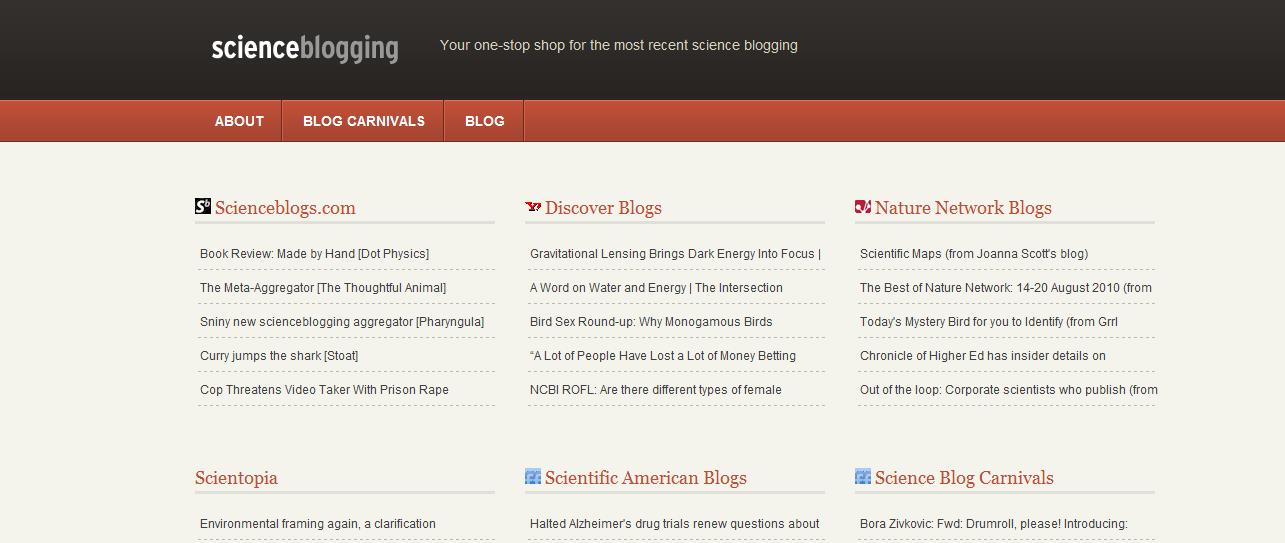
If you are quite keen on keeping up with the ever-changing science blog ecosystem, then a must visit website is the newly created ScienceBlogging.org:

Created by Anton Zuiker (MisterSugar), Bora Zivkovic (A Blog Around The Clock) and Dave Munger (Word Munger), the site aggregates all the major science group blogs, blogging networks, aggregators and services. Great stuff. They also have a blog.

Evolution of Colour Terms: 4 Learning Constraints

Continuing my series on the Evolution of Colour terms, this post reviews how learning constrains colour naming. For the full dissertation and for references, go here.

Continue reading “Evolution of Colour Terms: 4 Learning Constraints”

Some Links #15: Empires of the Word & anti-Babel

Empires of the Word & anti-Babel. It’s a few days old now but I’ve only just had time to read it. Anyway, check out Razib’s review of Empires of the Word: A Language History of the world. Lots of information for budding historical linguists and those intrigued by language spread and extinction. Particularly relevant is the following paragraph:

As I indicated above Empires of the Word is rather thin on robust generalizations. But one point which the author mentions repeatedly is that the rise and fall of languages of great expanse and utility is the norm, not the exception. In particular, Nicholas Ostler takes time out to emphasize that languages which spread via trade often do not have long term staying power. Portuguese, Aramaic, Punic and Sogdian would fall into this category (the later success of Portuguese was a matter of rice and empire in Brazil). It seems that mercantile communities are too ephemeral, that successive historical shocks inevitably result in their decline when there isn’t a peasant demographic reservoir or imperial power which imposes it by fiat. Even those languages which eventually spread beyond traders and gain cultural and political cachet may fall from grace. Greek is the best case of this. It was the dominant language of the Roman East, and spoken as far as modern Pakistan, and studied in Dark Age Ireland. By the early modern period it was a strange and foreign language in the West, and with the rise of Islam in the east it lost its cultural glamor, and even those Christians in Arab lands who were Melkite, Greek Orthodox who adhered to the theological position of Constantinople, became Arab in speech and identity (in greater Syria the Greek Orthodox have been instrumental in the formulation of Arab nationalism).

Opening a bibliography database for human evolution. Again, it’s been a few days since this was posted, but I’d advise anyone interested in human evolution visit John Hawks recently announced database. The bibliography section also has an RSS feed which provides a chronological list (newest first).

In which I apply for a job as a homeopath… Dave over at Anomalous Disaster has a great little post on him applying for a position at NHS Tayside for a homeopathic specialist. This is from the very same health board who recently brought us the sacking of 500 staff. So Dave decided to apply, which, at a cushy £68,000 salary, is definitely a job worth pursuing — after all, it can’t be that hard to dispense magic beans and provide a pseudo-scientific air of authority. Here is part of his letter of application:

The original research that I have published means that I am familiar with the body of published work on homeopathy, and the many meta-analyses and systematic reviews conducted on it. The fact that these conclude that homeopathy is no more effective than a similarly administered placebo will not bother me whilst I am taking advantage of some of the excellent salmon fishing to be found in the Tayside region. Indeed, given the fact the position only calls for the successful applicant to attend two sessions per week, I should imagine I would have plenty of time to indulge in a bit of fishing.

Click here to apply.

Selfish Sounds: Darwinism in linguistics. A brief(ish) article on the work of historical linguist, Nikolaus Ritt, and how words and sounds compete for the purpose of being replicated. Specifically, it looks at how the sound shapes of English words have gradually evolved:

Good examples of such phenomena are sets of changes which are obviously directed but unfold over time spans that are impossible to even survey by individual speakers. They have come to be known as ‘drifts’. A case of such a drift seems to have affected the sound shapes of English words (or better: lexical morphemes, i.e. the smallest linguistic units that carry meaning). Over time their shapes seem to have gradually evolved in a direction where they came to fit better into the rhythmical patterning that characterises English speech. “For instance, vowels in long words tended to be shortened over time, while vowels in short words tended to be lengthened. Thus, the rhythmic units they established became more uniform”, Nikolaus Ritt explains.

[…] From the evolutionary perspective this kind of development is best understood if one regards rhythm as an environmental constant in the linguistic world in which words and the sounds they are made up of have to survive and replicate. Because of the constant environmental pressure which rhythm exerts on them, the sound shapes of English words have gradually changed to become better adapted to the rhythmically structured utterances through which they get expressed and transmitted.
New Blog: Culture Evolves!

… Well, new to me at least. It’s run by Fiona Jordan of the Max Planck Institute for Psycholinguistics, and her latest post is an interview with one of my favourite researchers, Simon Greenhill (I didn’t know he designed a sudoku solving program). Also, after having done a little digging into her publications, I found the following forthcoming paper: The effect of population size and density on rates of linguistic evolution. Here is the abstract:

Evolutionary theory from population genetics predicts that demography may play an important role in determining the rate at which cultural and linguistic traits change over time. However, relatively few studies have explored this relationship for language at an appropriate scale and in a quantitative way, nor controlled for the problem of non-independence induced by the historical relationships between languages. Here we use phylogenetic trees of 351 Austronesian languages to test whether the rate of change in core vocabulary is affected by population size and population density. We detected a strong phylogenetic signal in both population size and density, indicating the need for historical control. We find a significant inverse relationship between lexical replacement and population size, no relationship with population density, and we confirm that splitting events influence lexical evolution. These results support the idea that a process analogous to genetic drift may be an important factor in lexical evolution. Furthermore, the strong phylogenetic signal in these demographic factors suggests that despite repeated population splits the social conditions that influence speech community size and density are maintained and inherited from one generation to the next.

I’m not going to say anything on a paper I haven’t yet read, other than it looks pretty cool and that more people should be considering the influence of demographic factors in linguistics.

Evolution of Colour Terms: 3 Perceptual Constraints

Continuing my series on the Evolution of Colour terms, this post reviews evidence for perceptual constraints on colour terms. For the full dissertation and for references, go here.

Continue reading “Evolution of Colour Terms: 3 Perceptual Constraints”

Evolution of Colour Terms: 2 Environmental Constraints

Continuing my series on the Evolution of Colour terms, this post reviews evidence for environmental constraints on colour perception. For the full dissertation and for references, go here.

Continue reading “Evolution of Colour Terms: 2 Environmental Constraints”