How and Why did Madness Evolve??

I’m reading a book at the minute called ‘The descent of madness: Evolutionary Origins of Psychosis and the Social Brain’ by Jonathan Burns. I thought I’d summarise some of the theories in the book as to how schizophrenia came about, for the principle reason that it’s very bloody interesting.

Some evolutionary thinkers have posited that schizophrenia is a recent disorder which is a modern response to the stresses of the industrial and technological age. Burns argues against this and claims that there is evidence of schizophrenia from early human history.

So, how and why did schizophrenia evolve when it has such a maladaptive nature? It’s certainly not being selected out because the phenotype still persists with a similar rate of incidence across the human race.

The Adaptionist Programme has a solution for this problem of mental disorders in that it views them as behavioural traits which evolved due to an advantage for the the individual in the ‘ancestral environment’, however, now, in a world which has changed and become psychologically stressful, a mismatch is created between the evolved trait and the modern environment.

The persistence of the phenotype can also be explained by taking into account the fact that psychotic illness has a continuum on which schizophrenia is a severe end of the spectrum, because of this other phenotypes on the genetic spectrum could harbour particularly adaptive traits. Genetically related but unaffected individuals who share some of the milder features of the illness may possess some kind of evolutionary advantage and hence the phenotype would linger.

The hypotheses above are plausible by Jonathan Burns claims he has a better solution:

Our hominid ancestors evolved a sophisticated neural network supporting social cognition and adaptive interpersonal behaviour (in other words the social brain). This has been identified, using functional imaging, to be comprised in the fronto-temporal and fronto-parietal cortical networks. Psychosis (and schizophrenia in particular) are characterised by functional and structural deficits in these areas and hence the term ‘social brain disorders’ are fitting.

Schizophrenics display abnormalities in a wide range of social cognition tasks such as emotion recognition, theory of mind and affective responsiveness and as a result individuals with schizophrenia find themselves disadvantaged in the social arena and vulnerable to the stresses of their complex social environments.

So, since there is such evidence to support that the areas which comprise our ‘social brains’ are the same regions which contribute to the disorder of schizophrenia when functional and structural deficits are present it becomes clear that schizophrenia exists as a consequence to the complex social brain.

This is a desirable hypothesis due to the fact that it does not rely on a Cartesian model of an isolated ethereal mind separated from body and environment, and instead concentrates on a physically and socially integrated construct of mind, embodied in the living world.

Interesting.

I’d just like to add a small disclaimer which says that I’m not an expert in schizophrenia or pretty much anything I’m writing about here (I haven’t even finished the book) so sorry if I’ve got anything hideously wrong. Please tell me. I’ll revisit this with extra thoughts on the subject once I have finished the book.

In other news and on the subject of evolutionary psychology here’s a really fun and ridiculously geeky thing I found:

Evolutionary Psychology Bingo!

What Makes Humans Unique? (I): The Evolution of the Human Brain

ResearchBlogging.org

Hello! This is my first post here at Replicated Typo and I thought I’d start with reposting a slightly modified version of a three-part series on the evolution of the human mind that I did last year over at my blog Shared Symbolic Storage.

So in this and my next posts I will have a look at how human cognition evolved from the perspective of cognitive science, especially ‘evolutionary linguistics,’ comparative psychology and developmental psychology.

In this post I’ll focus on the evolution of the human brain.

Human Evolution

We are evolved primates. (As are all other primates of course. So maybe it is better to say that we, like all other primates, are evolved beings with a unique set of specializations, adaptations and features. )
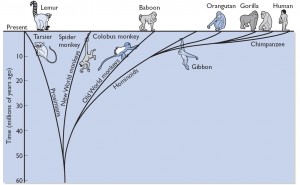
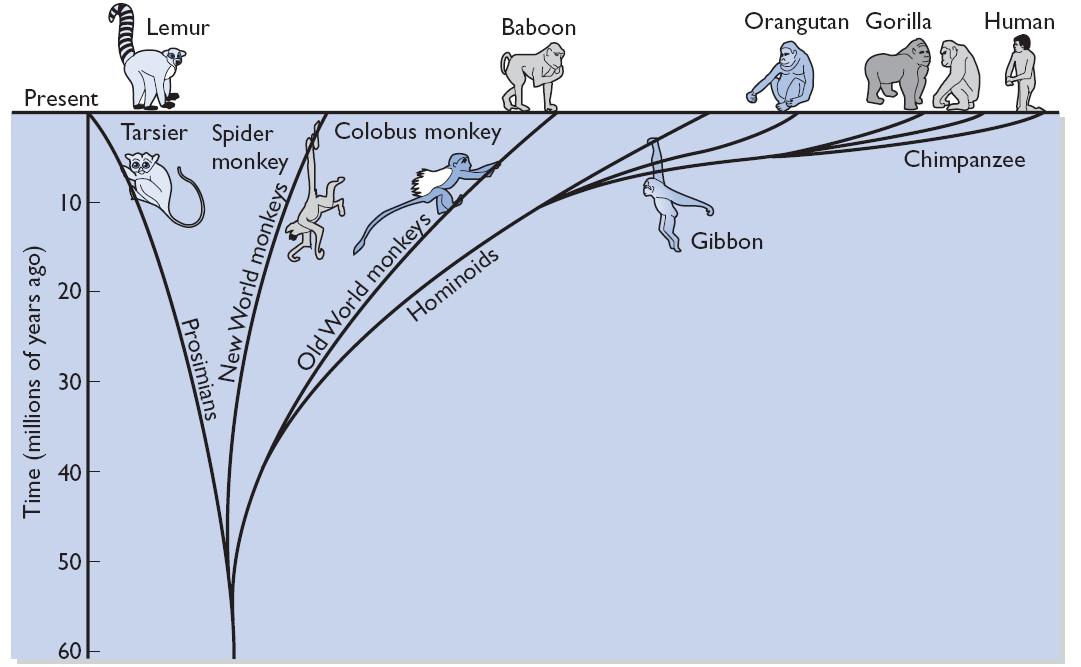
In our lineage, we share a common ancestor with orangutans (about 15 million years ago (mya)), gorillas (about 10mya), and most recently, chimpanzees and bonobos (5 to 7 mya). We not only share a significant amount of DNA with our primate cousins, but also major anatomical features (Gazzaniga 2008: 51f., Lewin 2005: 61) These include, for example, our basic skeletal anatomy, our facial muscles, or our fingernails (Lewin 2005: 218ff.).

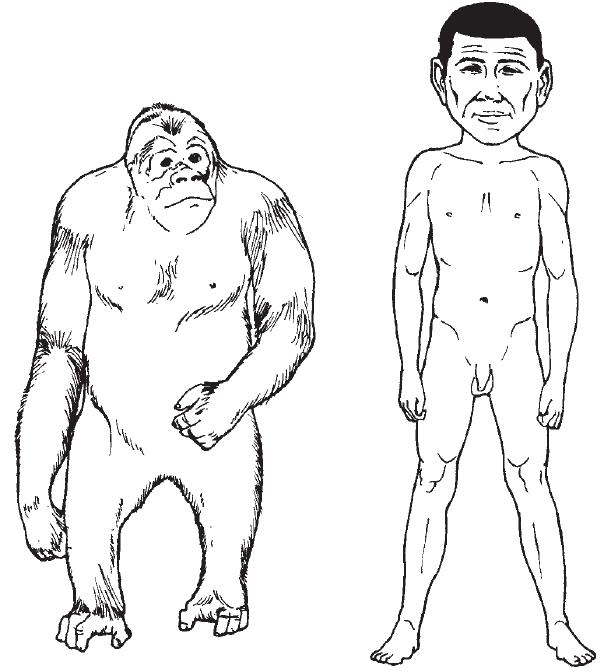
What most distinguishes us as humans on an anatomical level are our bizarre hair distribution, our upright posture and the skeletal modifications necessary for it, including a propensity for endurance running, our opposable thumbs, fat deposits that are unusually extensive (Preuss 2004: 5), and an intestinal tract only 60% the size expected of primates our size (Gibbons 2007: 1558).
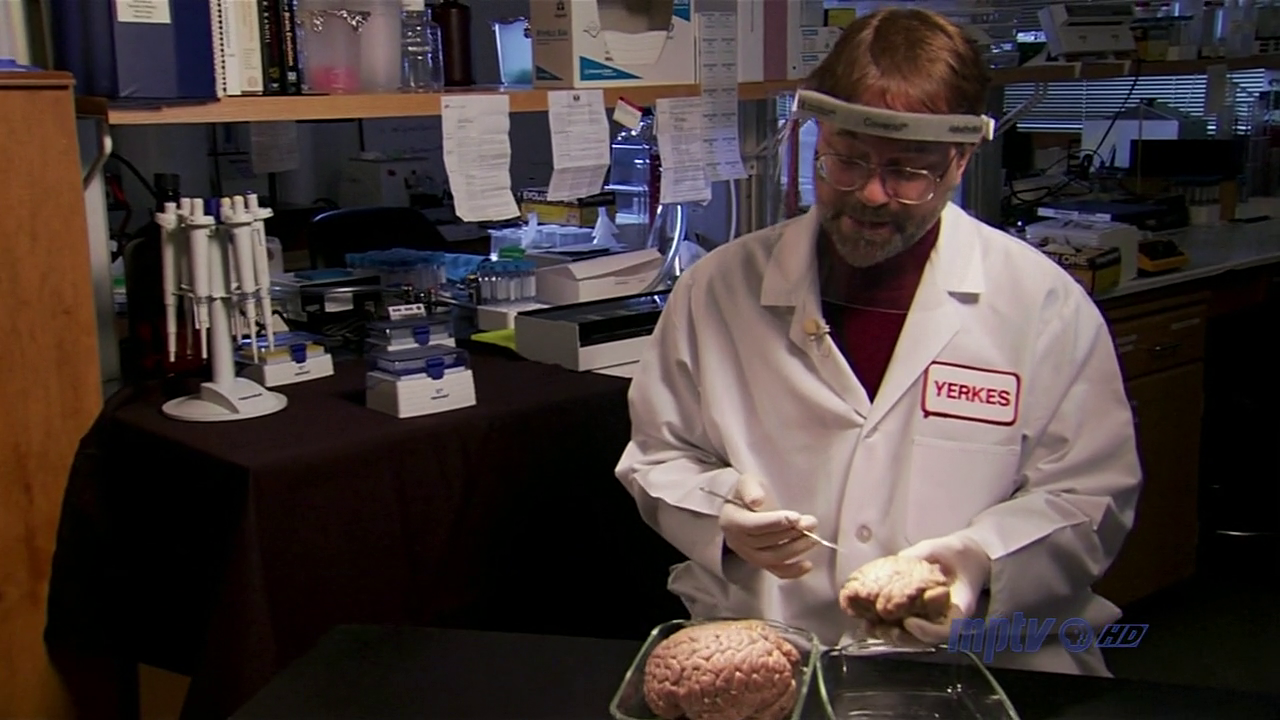
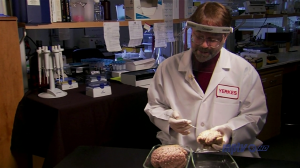
Finally, there is also a distinguishing feature that is a much more remarkable violation of expectations – a brain three times the size expected of a primate our size. This is all the more interesting as primates are already twice as encephalized as other mammals (Lewin 2005: 217). A direct comparison shows this difference in numbers: Whereas human brains have an average volume of 1251.8 cubic centimetres and weigh about 1300 gram, the brains of the other great apes only have an average volume of 316.7 cubic centimetres and weigh between 350-500 gram (Rilling 2006: 66, Preuss 2004: 8). In a human brain, there are approximately a hundred billion neurons, each of which is connected to about one thousand other neurons, comprising about one hundred trillion synaptic connections (Gazzaniga 2008: 291). If you would count all the connections in the napkin-sized cortex alone, you’d only be finished after 32 million years (Edelman 1992: 17).

Expensive Tissue

The human brain is also extremely “expensive tissue” (Aiello & Wheeler 1995): Although it only accounts for 2% of an adult’s body weight, it accounts for 20-25% of an adult’s resting oxygen and energy intake (Attwell & Laughlin 2001: 1143). In early life, the brain even makes up for up 60-70% of the body’s total energy requirements. A chimpanzee’s brain, in comparison, only consumes about 8-9% of its resting metabolism (Aiello & Wells 2002: 330). The human brain’s energy demands are about 8 to 10 times higher than those of skeletal muscles (Dunbar & Shultz 2007: 1344), and, in terms of energy consumption, it is equal to the rate of energy consumed by leg muscles of a marathon runner when running (Attwell & Laughlin 2001: 1143). All in all, its consumption rate is only topped by the energy intake of the heart (Dunbar & Shultz 2007: 1344).

Consequently, if we want to understand the evolutionary trajectory that led to human cognition there is the problem that

“because the cost of maintaining a large brain is so great, it is intrinsically unlikely that large brains will evolve merely because they can. Large brains will evolve only when the selection factor in their favour is sufficient to overcome the steep cost gradient“ (Dunbar 1998: 179).

This is especially important for people who want to come up with an “adaptive story” of how our brain got so big: they have to come up with a strong enough selection pressure operative in the Pleistocene “environment of evolutionary adaptedness” that would have allowed such “expensive tissue” to evolve in the first place (Bickerton 2009: 165f.).

What About the Brain is Uniquely Human?

If we look to the brain for possible hints, we first find that presently, there is “no good evidence that humans do, in fact, possess uniquely human cortical areas” (although the jury is still out) (Preuss 2004: 9). In addition, we find that there are functions specific to humans which are represented in areas homologous to areas of other primates. Instead, it seems that in the course of human evolution some of the areas of the brain expanded disproportionally, “especially higher-order cortical areas, including the prefrontal cortex” (Preuss 2004: 9, Deacon 1998: 435-438). This means that humans are not simply ‘better’ at thinking than other animals, but that they think differently (Preuss 2004: 7). The expansion and apparent specializations of only certain kinds of neuronal areas could indicate a qualitative shift in neuronal activity brought about by re-organization of existing features, leading to a wholly different style of cognition (Deacon 1998: 435-438 Rilling 2006: 75).
This scenario squares well with what we know about the way evolution works, namely that it always has to work with the raw materials that are available, and constantly co-opts and tinkers with existing structures, at times producing haphazard, cobbled-together, but functional results (Gould & Lewontin 1979, Gould & Vrba 1982). Given the relatively short time span for the evolution of the “most complex structure in the know universe”, as it is sometimes referred to, we have to acknowledge how preciously little time the evolutionary process had for ‘debugging.’ It could well be that make the human mind is so unique because it is an imperfect ‘Kluge:’ “a clumsy or inelegant – yet surprisingly effective – solution to a problem,” like the Apollo 13 CO2 filter or an on-the-spot invention by MacGyver (Marcus 2008: 3f.). It may thus well turn out that what we think makes us so special is a mental “oddity of our species’ way of understanding” the world around us (Povinelli & Vonk 2003: 160). It is reasonable then to assume that human cognition did not just simply get better across the board, but that instead we owe our unique style of thinking to quite specific specializations of the human mind.

With this in mind, we can now ask the question how these neurological differences must translate into psychological differences. But this is where the problem starts: Which features really distinguish us as humans and which are more derivative than others? A true candidate for what got uniquely human cognition off the ground has to pass this test and solve the problem how such “expensive tissue” could evolve in the first place.

In my next post I will have a look at six candidates for what makes human cognition unique.

References:

Aiello, L., & Wheeler, P. (1995). The Expensive-Tissue Hypothesis: The Brain and the Digestive System in Human and Primate Evolution Current Anthropology, 36 (2) DOI: 10.1086/204350

Aiello, L., & Wells, J. (2002). ENERGETICS AND THE EVOLUTION OF THE GENUS HOMO Annual Review of Anthropology, 31 (1), 323-338 DOI: 10.1146/annurev.anthro.31.040402.085403

Attwell, David and Simon B. Laughlin. (2001.) “An Energy Budget for Signaling in the Grey Matter of the Brain.” Journal of Cerebral Blood Flow and Metabolism 21:1133–1145.

Bickerton, Derek (2009): Adams Tongue: How Humans Made Language. How Language Made Humans. New York: Hill and Wang.

Deacon, Terrence William (1997). The Symbolic Species. The Co-evolution of Language and the Brain. New York / London: W.W. Norton.

Dunbar, Robin I.M. (1998): “The Social Brain Hypothesis Evolutionary Anthropology 6: 178-190.

Dunbar, R., & Shultz, S. (2007). Evolution in the Social Brain Science, 317 (5843), 1344-1347 DOI: 10.1126/science.1145463

Edelman, Gerald Maurice (1992) Bright and Brilliant Fire: On the Matters of the Mind. New York: Basic Books

Gazzaniga, Michael S. (2008): Human: The Science of What Makes us Unique. New York: Harper-Collins.

Gibbons, Ann. (2007) “Food for Thought.” Science 316: 1558-1560.

Gould, Stephen Jay and Richard Lewontin (1979): “The spandrels of San Marco and the Panglossian paradigm: a critique of the adaptationist programme.” Proclamations of the Royal. Society of London B: Biological Sciences 205 (1161): 581–98.

Gould, Stephen Jay, and Elizabeth S. Vrba (1982), “Exaptation — a missing term in the science of form.” Paleobiology 8 (1): 4–15.

Lewin, Roger (2005): Human Evolution: An Illustrated Introduction. Oxford: Blackwell.

Marcus, Gary (2008): Kluge: The Haphazard Evolution of the Human Mind. London: Faber and Faber.

Povinelli, Daniel J. and Jennifer Vonk (2003): “Chimpanzee minds: Suspiciously human?” Trends in Cognitive Sciences, 7.4, 157–160.

Preuss Todd M. (2004): What is it like to be a human? In: Gazzaniga MS, editor. The Cognitive Neurosciences III, Third Edition. Cambridge, MA: MIT Press: 5-22.

Rilling, J. (2006). Human and nonhuman primate brains: Are they allometrically scaled versions of the same design? Evolutionary Anthropology: Issues, News, and Reviews, 15 (2), 65-77 DOI: 10.1002/evan.20095
Some Links #12: What if there had never been a cognitive revolution?

What if there had never been a cognitive revolution? Apparently, nothing would really be all that different according to Nicolas Baumard over at ICCI. It’s all speculative, in a similar vein to alternative history fiction (I recommend: Making History by Stephen Fry and Difference Engine by William Gibson and Bruce Sterling), with Baumard stating:

My point here is that these key ideas would have emerged even without a Cognitive Revolution. Take for instance the idea that the mind cannot be a blank slate. This idea is totally natural to evolutionary biologists. What about the mind as “a complex system composed of many interacting parts”? Without going back to La Mettrie, Hutcheson or Descartes, one can argue that the idea of modularity is at the core of the research program of neuropsychology since its beginning (the same is true, albeit at a lesser degree, for evolutionary biology). We should not forget as well that, with or without the Cognitive Revolution, brain imaging techniques would have emerged and would have joined neuropsychology and evolutionary biology in decomposing the mind. Add the methodological advances of developmental psychology or social psychology – which were not part of the Cognitive revolution – and you get a pretty big part of today’s ‘Cognition and Culture’.

‘Mad Men -ese. Ben Zimmer has a cool article on Mad Men (easily one of the best shows to have emerged in recent years) and its dedication to accurately portraying 1960s dialogue. But with such dedication comes equally dedicated, and pedantic, criticisms of some of the lines used. For example, Zimmer points to Don’s line “The window for this apology is closing” as being tied to the 70s use of window in a metaphorical sense. On another note: the new season of Mad Men begins tomorrow (25th June) in America.

A growing isolated brain can organize itself. Deric Bownds points to an article by Zhou et al (2010) which disconnected a mouse’s neocortex from the rest of its brain to see how the surface map developed. The results:

During these weeks, the mutant mice, despite having disconnected brains, display a variety of behaviors: eating, drinking, walking, and swimming. Thus, “protomap” formation, namely cortical lamination and formation of areas, proceed normally in absence of extrinsic connections, but survival of projection neurons and acquisition of mature morphological and some electrophysiological features depend on the establishment of normal cortical–subcortical relationships.

Things I’d like to see: a nice, simple, colourful website on evidence-based social policy. Being an avid reader of Ben Goldacre’s Bad Science column, and having read his book of the same name, I was surprised to find that he has another blog. Anyway, the linked post is fairly self-explanatory: he’s calling for someone to create a website looking at evidence-based social policy (something he’s been discussing since at least 2007). I’m a big fan of this idea, which would see social policy based on less rhetorical wrangling and more on actual evidence:

There are three key stages in evidence-based practise: you generate evidence; you collate and appraise it, and then you disseminate and implement. It feels to me like the last bit is currently underdone, and often it takes one clear information hub, or an organisation devoted to promoting something, to move things on.

Why money makes you unhappy. Money is apparently not very good at making us happy. Jonah Lehrer writes about a study exploring the experience-stretching hypothesis, and how it relates to money and happiness. Basically, the argument is that because money allows us to enjoy the best things in life, we actually end up lessening our ability to enjoy the mundane aspects of our life. As the mundane aspects are most frequent, then this isn’t necessarily a good thing. This comes on the back of another paper claiming that the United States, currently the richest nation on Earth, is slowly getting less satisfied with life.  As the current study states:

Taken together, our findings provide evidence for the provocative notion that having access to the best things in life may actually undermine one’s ability to reap enjoyment from life’s small pleasures. Our research demonstrates that a simple reminder of wealth produces the same deleterious effects as actual wealth on an individual’s ability to savor, suggesting that perceived access to pleasurable experiences may be sufficient to impair everyday savoring. In other words, one need not actually visit the pyramids of Egypt or spend a week at the legendary Banff spas in Canada for one’s savoring ability to be impaired—simply knowing that these peak experiences are readily available may increase one’s tendency to take the small pleasures of daily life for granted.

Where Are Memes?

This is more a public note to myself than anything else. It’s likely to seem a bit odd to those who haven’t been following my thinking on memes. Cross-posted at New Savanna.

Back in 1996 I published a long article, Culture as an Evolutionary Arena (link to downloadable PDF), in the, alas, now defunct, Journal of Social and Evolutionary Systems. In that article I introduced the notion of units of cultural inheritance with these paragraphs:

Following conversations with David Hays, I suggest that we regard the whole of physical culture as the genes: the pots and knives, the looms and cured hides, the utterances and written words, the ploughshares and transistors, the songs and painted images, the tents and stone fortifications, the dances and sculpted figures, all of it. For these are the things which people exchange with one another, through which they interact with one another. They can be counted and classified and variously studied.

What then of the ideas, desires, emotions, and attitudes behind these things? After all, as any college sophomore can point out, words on a page are just splotches unless apprehended by an appropriately prepared mind, one that knows the language. Pots and knives are not so ineffable as runes and ideograms, but they aren’t of much use to people who don’t know how to use them, that is, to people whose minds lack the appropriate neural “programs”. Surely, one might propose, these mental objects and processes are the stuff of culture.

What I in fact propose is that we think of these mental objects and processes as being analogous to the biologist’s phenotype just as the physical objects and processes are analogous to the genotype. Properly understood, these mental objects and processes are embodied in brain states (cf. Benzon and Hays 1988). Thus we have the whole of physical culture interacting with the inner cultural environment to produce the various mental objects and activities which are the substance of culture.

Richard Dawkins has proposed the term “meme” for the units of the cultural genotype, but proposes no special term for the cultural phenotype, though he recognizes the necessity of distinguishing the two (Dawkins 1982, pp. 109 ff., see also Dawkins 1989, pp. 189 ff.). Following more or less standard anthropological usage, I offer “psychological trait”, or just “trait”, as a term designating phenotypical units or features. Note, however, that Dawkins places memes in the brain and traits in the external world, which is just the opposite of what I am doing.

I have maintained that position until quite recently, say a week or two ago. I am now considering abandoning that conception. But first, a little more about how I further developed it.

In my 2001 book on music, Beethoven’s Anvil, I developed that idea with respect to music, arguing that the neural ‘trace’ (trajectory in neural state space) of musical performances is a cultural phenotype while the memes are those aspects of musical sound around which individuals coordinate their music-making activities. I further developed this idea only a few weeks ago in a series of posts I wrote as background to a post I did for the National Humanities Center on cultural evolution.

Continue reading “Where Are Memes?”

Language – An Embarrassing Conundrum for the Evolutionist?

Hello! This is my first post on the blog and whilst I didn’t want it to be an angry rant after I found this youtube video there seemed little could have been done to avoid it.

This is a video by a creationist named “ppsimmons” who writes on the front page of his youtube channel that he “apologizes for not knowing enough to scientifically refute the evidence for creation nor for being clever enough to “scientifically” support the theory of evolution.” And yet he feels to be enough of an authority to make videos refuting evolution using ‘science’.

I know I shouldn’t let this annoy me as much as it obviously has, I know that there will always be creationists out there and I know that these creationists will never listen to anything I have to say. However, in this case, I’ve decided to respond mostly to set straight the interpretation of Robert Berwick’s words used in this video.

Continue reading “Language – An Embarrassing Conundrum for the Evolutionist?”

The Media Noose: Copycat Suicides and Social Learning

This post was chosen as an Editor's Selection for ResearchBlogging.orgResearchBlogging.orgI always remember 2008 as the year when the entire UK media descended upon the former mining town of Bridgend. The reason: over the course of two years, 24 young people, most of whom were between the ages of 13 and 17, decided to commit suicide. At the time I was working in Bridgend, so I’m able to appreciate the claims of local MP, Madeleine Moon, that media influence had become part of problem. After all, most editors will tell you: the aim is to sell newspapers. And when this rule is rigorously applied, it should not come as a surprise at the depths some journalists will sink to recycle a news story. Even at a local-level, where you’d think some civic responsibility might exist, journalists clambered over themselves to find a new angle, generating ridiculous claims such as: electromagnetic waves from mobile phones caused the suicides.

Continue reading “The Media Noose: Copycat Suicides and Social Learning”

Some Links #11: Linguistic Diversity or Homogeneity?

Linguistic Diversity = Poverty. Razib Khan basically argues, correctly in my opinion, that linguistic homogeneity is good for economic development and general prosperity. From the perspective of a linguist, however, I do like the idea of really obscure linguistic communities, ready and waiting to be discovered and documented. On the flip side, it is selfish of me to want these small communities to remain in a bubble, free from the very same benefits I enjoy in belonging to a modern, post-industrialised society. Our goal, then, should probably be more focused on documenting, as opposed to saving, these languages. Razib has recently posted another, quite lengthy post on the topic: Knowledge is not value-free.

When did we first ‘Rock the Mic’? A meeting of my two favourite interests over at the New York Times: Linguistics and Hip Hop. Ben Zimmer writes:

In “Rapper’s Delight,” the M.C. Big Bank Hank raps, “I’m gonna rock the mic till you can’t resist,” using what was then a novel sense of rock, defined by the O.E.D. as “to handle effectively and impressively; to use or wield effectively, esp. with style or self-assurance.” To be sure, singers in the prerap era often used rock as a transitive verb, whether it was Bill Haley promising, “We’re gonna rock this joint tonight,” or the bluesman Arthur “Big Boy” Crudup more suggestively wailing, “Rock me, mama.” But the M.C.’s of early hip-hop took the verb in a new direction, transforming the microphone (abbreviated in rap circles as mic, not mike) into an emblem of stylish display. Later elaborations on the theme would allow clothes and other accessories to serve as the objects of rock, as when Kanye West boasted in a 2008 issue of Spin magazine, “I rock a bespoke suit and I go to Harold’s for fried chicken.”

It’d be nice to see more stuff on linguistics and hip hop, and, having said that, I might write a bit on the subject. In fact, I would go as far as to say that hip hop is part of reason why I fell into linguistics: the eloquent word play encouraged, and perhaps moulded, my fascination with language. To demonstrate why, here’s a track by Maryland rapper, Edan, who certainly knows how to rock the mic:

Edan — One Man Arsenal

Life without language. Neuroanthropology provides yet another great read. This time it’s on the topic of life without language — something that’s always crept into my thoughts, yet seems impossible to imagine (as I’m already so embedded within a language-using society). The post goes on to discuss Susan Schaller and the case of a profoundly deaf Mexican immigrant who did not learn sign language:

The man she would call, ‘Ildefonso,’ had figured out how to survive, in part by simply copying those around him, but he had no idea what language was. Schaller found that he observed people’s lips and mouth moving, unaware that they were making sound, unaware that there was sound, trying to figure out what was happening from the movements of the mouths. She felt that he was frustrated because he thought everyone else could figure things out from looking at each others’ moving mouths.

One problem for Schaller’s efforts was that Ildefonso’s survival strategy, imitation, actually got in the way of him learning how to sign because it short-circuited the possibility of conversation. As she puts, Ildefonso acted as if he had a kind of visual echolalia (we sometimes call it ‘echopraxia’), simply copying the actions he saw

One Man’s Take on the Facts of the Matter. Babel’s Dawn takes a look at Tecumseh Fitch’s book, The Evolution of Language, and concisely explains a clear departure between two camps in evolutionary linguistics:

One clear difference between the scenarios is in the role of the individual in relation to language. Language is somehow built into the brain in Chomsky’s thought-first scenario, while it is learned from others in the topics-first approach. Empiricists, like Morten Christiansen and Nicholas Chater, see language as ‘out there’ to be learned while nativists, like Fitch and Chomsky, say there is an internal, I-language, and the language out there is merely the sum of all those little I-languages. How to settle the dispute? Look for factual evidence.

Noam Chomsky: Inventor of Linguistics… Huh?

I just started reading Johann Hari’s latest article about Noam Chomsky, and I was welcomed to this interesting fact:

Noam Chomsky is one of the most hysterically abused figures in the world today. Even his critics have to concede that his work inventing the field of linguistics — and so beginning to decode the structure of how language is formed in the human brain — makes him one of the most important intellectuals alive.

I agree that Chomsky is an important intellectual figure, and his massive contributions to linguistics are well-documented, but he did not invent the field. Some might say reinvented… Although, I’m not sure how favourably history will view Chomsky’s shadow having loomed over linguistics for such a long time. My own opinion, for what it’s worth, is that he’s largely been a positive influence, even if I find myself disagreeing with a lot of his major ideas.

A history of evolution pt.1: Ancient Greece to Lamarck

The limitations of geological periods, imposed by physical science, cannot, of course, disprove the hypothesis of transmutation of species; but it does seem sufficient to disprove the doctrine that transmutation has taken place through ‘descent with modification by natural selection’. — Lord Kelvin (Of Geological Dynamics, 1869).

It might seem odd that I start a post about evolution with a quote claiming natural selection is inadequate to account for the transmutation of species. It is, though, highly relevant to what I’m going to discuss in the post, and strikes at the heart of why it’s fundamental for us to understand the theory of evolution by natural selection. See, in 1869, Lord Kelvin’s position was fairly reasonable, and, as you’d expect for a man of such high scientific standing, the available evidence in physics did seem to conflict with Darwin’s theory. The Sun was one particularly salient point of contention: to get the diversity of species we see on Earth, evolution needs a long time to work (on the order of hundreds of millions, if not billions of years), yet according to 19th-century physics the Sun could only have been burning for 40-million years.

Continue reading “A history of evolution pt.1: Ancient Greece to Lamarck”

Some Links #10: Poo lady tweets shit

Gillian McKeith: You are what you tweet. If you thought the subject of my title was some five-year who just discovered various nouns for his excrement, then you’re not far off: Gillian McKeith is back, and like any bad-sequel she’s saying the same shit, just repackaged into an eerily similar set of events. What I particularly loved about this article is McKeith’s denial that she’s actually the McKeith in question. Confused? Head over and read the article. It’s short and fun.

A strong dose of regulation will keep the health food industry regular. Interesting article by Martin Robbins (of Lay Scientist) over at the Guardian. I’m not normally one for regulation: I think it’s often a backwards way of looking at an issue. And I’m definitely against our ridiculous zeal for legislation-only solutions. But I do think in the case of the health food industry regulation and legislation are fantastically effective. To bring it back to the post above: McKeith has literally made millions through the exploitation of a weakly controlled industry. Ultimately, though, I do think we need to also consider the other effective weapon against these erroneous claims: education. After all, those who know, know not to buy.

I Write Like… H.P. Lovecraft, apparently. It probably explains the lack of comments on my posts: people are scared shitless. It’s okay, I’m not a venomous wordsmith, just a former linguistics student searching for a new university to call home. See, not so scary now… Click the link if you fancy wasting a minute or so of your time.

The Price of Altruism. I always remember first learning about the Price equation at university, and the sad story of its progenitor, George Price, who committed suicide in 1975. Over a Gene Expression, Razib Khan has written a fantastic, in-depth review of Oren Harman’s book, The Price of Altruism. There are too many snippets of information to pick out for a summary, but here’s an ironically amusing section:

The “hawk” and “dove” morphs made famous by Richard Dawkins in The Selfish Gene go back to Maynard Smith’s work, but the terms themselves were of Price’s invention according to Harman. If I read Harman’s chronology correctly Price was already a fervent Christian by this time, having left atheism in the same period as he launched his career as an evolutionary biologist, and there is some hint that the term “dove” may have been influenced by his particular religious leanings. This possibility seems all the more amusing in light of Dawkins’ later career as an atheist polemicist.

Matt Ridley: When Ideas Have Sex. Love him for his biology, or loathe him for his economics, you can’t help but nod in agreement with Matt Ridley’s TED talk. I think he over emphasizes this apparent trend of good times to come. He clearly hasn’t read Taleb’s Black Swan (and probably isn’t all too interested given his risk-taking strategies at Northern Rock). But his stuff on trade and cultural evolution is fairly rock solid from my perspective.