Some Links #13: Universal Grammar Haters

Universal Grammar haters. Mark Lieberman takes umbrage with claims that Ewa Dabrowska’s recent work challenges the concept of a biologically evolved substrate for language. Put simply: it doesn’t. What their experiments suggest is that there are considerable differences in native language attainment. As some of you will probably know, I’m not necessarily a big fan of most UG conceptions, however, there are plenty of papers that directly deal with such issues. Dabrowska’s not being one of them. In Lieberman’s own words:

In support of this view, let me offer another analogy. Suppose we find that deaf people are somewhat more likely than hearing people to remember the individual facial characteristics of a stranger they pass on the street. This would be an interesting result, but would we spin it to the world as a challenge to the widely-held theory that there’s an evolutionary substrate for the development of human face-recognition abilities?

Remote control neurons. I remember reading about optogenetics awhile back. It’s a clever technique that enables neural manipulation through the use of light-activated channels and enzymes. Kevin Mitchell over at GNXP classic refers to a new approach where neurons are activated using a radio frequency magnetic field. The obvious advantage to this new approach being fairly straight-forward: magnetic-fields pass through brains far more easily than light. It means the new approach is a lot less invasive, without the need to insert micro-optical fibres or light-emitting diodes. Cool stuff.

Motor imagery enhances object recognition. Neurophilosophy has an article about a study showing that motor simulations may enhance the recognition of tools:

According to these results, then, the simple action of squeezing the ball not only slowed down the participants’ naming of tools, but also slightly reduced their accuracy in naming them correctly. This occured, the authors say, because squeezing the ball involves the same motor circuits needed for generating the simulation, so it interferes with the brain’s ability to generate the mental image of reaching out and grasping the tool. This in turn slows identification of the tools, because their functionality is an integral component of our conceptualization of them. There is other evidence that  parallel motor simulations can interfere with movements, and with each other: when reaching for a pencil, people have a larger grip aperture if a hammer is also present than if the pencil is by itself.

On the Origin of Science Writers. If you fancy yourself as a science writer, then Ed Yong, of Not Exactly Rocket Science, wants to read your story. As expected, he’s got a fairly large response (97 comments at the time of writing), which includes some of my favourite science journalists and bloggers. It’s already a useful resource, full of fascinating stories and bits of advice, from a diverse source of individuals.

Some thoughts about science blog aggregation. Although it’s still hanging about, many people, including myself, are looking for an alternative to the ScienceBlogs network. Dave Munger points to Friendfeed as one potential solution, with him setting up a feed for all the Anthropology posts coming in from Research Blogging. Also, in the comments Christina Pikas mentioned Nature Blogs, which, I’m ashamed to say, I haven’t come across before.

What Makes Humans Unique ?(III): Self-Domestication, Social Cognition, and Physical Cognition

ResearchBlogging.orgIn my last post I summed up some proposals for what (among other things) makes human cognition unique. But one thing that we should bear in mind, I think, is that our cognitive style may more be something of an idiosyncrasy due to a highly specific cognitive specialization instead of a definitive quantitative and qualitative advance over other styles of animal cognition. In this post I will look at studies which further point in that direction.

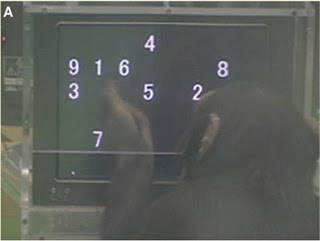
Chimpanzees, for example, beat humans at certain memory tasks  (Inoue & Matsuzawa 2007) and behave more rational in reward situations (Jensen et al. 2007).

In addition, it has been shown that in tasks in the social domain, which are generally assumed to be cognitively complex, domesticated animals such as dogs and goats (Kaminski et al. 2005) fare similarly well or even outperform chimpanzees.

Social Cognition and Self-Domestication

It is entirely possible that the first signs of human uniqueness where at first simply side-effects our self-domesticating lifestyle – the same way the evolution of social intelligence in dogs and goats is hypothesised to have come about –, acting on a complex primate brain (Hare & Tomasello 2005).

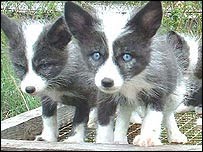
This line of reasoning is also supported by domesticated silver foxes which have been bred for tameness over a time period of 50 years but developed other interesting characteristics as a by-product: To quote from an excellent post on the topic over at a Blog Around the Clock (see also here):

“They started having splotched and piebald coloration of  their coats, floppy ears, white tips of their tails and paws. Their body proportions changed. They started barking. They improved on their performance in cognitive experiments. They started breeding earlier in spring, and many of them started breeding twice a year.”

What seems most interesting to me, however, is another by-product of their experimental domestication: they also improved in the domain of social cognition. For example, like dogs, they are able to understand human communicative gestures like pointing. This is all the more striking because, as mentioned above, chimpanzees do not understand human communicative gestures like  helpful  pointing. Neither do wolves or non-domesticated silver foxes (Hare et al. 2005).

Continue reading “What Makes Humans Unique ?(III): Self-Domestication, Social Cognition, and Physical Cognition”

Physicists get linguist envy?

So I wrote a post a couple of weeks ago on my Hungarian friend’s blog in which I wrote about, amongst other things, why some linguists have physics envy, but I just read a new scientist article in which it seems physicists can have linguistics envy too!

Murray Gell-Mann, a nobel prize winning physicist (who discovered quarks), has taken it upon himself to try to work out the origins of human language:

Another pet project is an attempt to trace the majority of human languages back to a common root. Since the 19th century, linguists have been comparing languages to infer their common ancestry, but in most cases, Gell-Mann says, this kind of analysis loses the trail 6000 or 7000 years back. He says most linguists insist it is impossible to follow the trail any further into the past and – this is what truly rankles with him – “absurdly, they don’t even want to try”.

Gell-Mann heads SFI’s Evolution of Human Languages (EHL) programme. The EHL linguists say they can go even further back by classifying language families into superfamilies and even into a super-superfamily. “What we’ve found,” Gell-Mann explains, “is tentative evidence for a situation in which a huge fraction of all human languages are descended from one spoken 20,000 years ago, towards the end of the last ice age.” The team does not claim to account for all languages, though, and remains agnostic about whether they can eventually do so. “All of this just comes from following the data,” he says.

I love that attempting to trace the majority of human languages back to a common root can be described as a ‘pet project’.

If anyone’s interested here’s a paper he wrote on the subject:

Murray Gell-Mann, Ilia Peiros, George Starostin. Distant Language Relationship: The Current Perspective.

Time Travel, Dreams and The Origin of Knowledge

I’ve been attending a weekly seminar on the Metaphysics of Time Travel, given by Alasdair Richmond.  Yesterday, he was talking about the way knowledge arises in causal chains.  Popper (1972 and various others) argues that “Knowledge comes into existence only by evolutionary, rational processes” (quoted from Paul Nahin, ‘Time Machines: Time Travel in Physics, Metaphysics and Science Fiction, New York, American Institute of Physics, 1999: 312).  Good news for us scholars of Cultural Evolution.  However, Richmond also talked about the work of David Lewis on the nature of causality.  There are three ways that causal chains can be set up:

The first is an infinite sequence of events each caused by the previous one.  For example, I’m typing this blog because my PhD work is boring, I’m doing a PhD because I was priced in by funding, I applied for funding because everyone else did … all the way back past my parents meeting and humans evolving etc.

The second option is for a finite sequence of events – like the first option, but with an initial event that caused all the others, like the big-bang.

The third option is a circular sequence of events.  In this, A is caused by B which is caused by A.  For instance, I’m writing doing a PhD because I got funding and I got funding because I’m doing a PhD, because I got funding.  There is no initial cause, the states just are. This third option seems really odd, not least because it involves time-travel.  Where do the states come from?  However, argues Lewis, they are no more odd than any of the other two options.  Option one has a state with no cause and option two has a cause for every event but no original cause.  So, how on earth can we get at the origin of knowledge if there is no logical possibility of determining the origin of any sequence of events?

One answer is just to stop caring after a certain point.  Us linguists are unlikely to get to the point where we’re studying vowel shifts in the first few seconds of the big bang.

The other answer is noise.  Richmond suggested that ‘Eureka’ moments triggered by random occurrences, for instance (Nicholas J. J. Smith, ‘Bananas Enough for Time Travel?’, British Journal for the Philosophy of Science, Vol. 48, 1997: 363-89). mishearing someone or a strange dream, could create information without prior cause.

Spookily, the idea I submitted for my PhD application came to me in a dream.

Culture-driven population dynamics: sustainable or unsustainable?

ResearchBlogging.org This post was chosen as an Editor's Selection for ResearchBlogging.orgWhen looking at culture-driven population dynamics, a common assumption is that there’s a positive feedback between cultural evolution and demographic growth. The general prediction, then, is for unlimited growth in population and culture. Yet models based on these assumptions tend to ignore important aspects of cultural evolution, namely: (1) cultural transmission is not perfect; (2) culture does not always promote population growth. Ghirlanda et al (2010) incorporate these two features into a model, and arrive at some interesting conclusions. In particular, they argue those populations maintaining large amounts of culture may run the risk of extinction rather than stability or growth.

Continue reading “Culture-driven population dynamics: sustainable or unsustainable?”

What Makes Humans Unique? (II): Six Candidates for What Makes Human Cognition Uniquely Human

ResearchBlogging.orgWhat makes humans unique? This never-ending debate has sparked a long list of proposals and counter-arguments and, to quote from a recent article on this topic,

“a similar fate  most likely awaits some of the claims presented here. However such demarcations  simply  have  to  be  drawn  once  and  again.  They  focus  our  attention, make us wonder, and direct and stimulate research, exactly because they provoke and challenge other researchers to take up the glove and prove us wrong.” (Høgh-Olesen 2010: 60)

In this post, I’ll focus on six candidates that might play a part in constituting what makes human cognition unique, though there are countless others (see, for example, here).

One of the key candidates for what makes human cognition unique is of course language and symbolic thought. We are “the articulate mammal” (Aitchison 1998) and an “animal symbolicum” (Cassirer 2006: 31). And if one defining feature truly fits our nature, it is that we are the “symbolic species” (Deacon 1998). But as evolutionary anthropologists Michael Tomasello and his colleagues argue,

“saying that only humans have language is like saying that only humans build skyscrapers, when the fact is that only humans (among primates) build freestanding shelters at all” (Tomasello et al. 2005: 690).

Language and Social Cognition

According to Tomasello and many other researchers, language and symbolic behaviour, although they certainly are crucial features of human cognition, are derived from human beings’ unique capacities in the social domain. As Willard van Orman Quine pointed out, language is essential a “social art” (Quine 1960: ix). Specifically, it builds on the foundations of infants’ capacities for joint attention, intention-reading, and cultural learning (Tomasello 2003: 58). Linguistic communication, on this view, is essentially a form of joint action rooted in common ground between speaker and hearer (Clark 1996: 3 & 12), in which they make “mutually manifest” relevant changes in their cognitive environment (Sperber & Wilson 1995). This is the precondition for the establishment and (co-)construction of symbolic spaces of meaning and shared perspectives (Graumann 2002, Verhagen 2007: 53f.). These abilities, then, had to evolve prior to language, however great language’s effect on cognition may be in general (Carruthers 2002), and if we look for the origins and defining features of human uniqueness we should probably look in the social domain first.

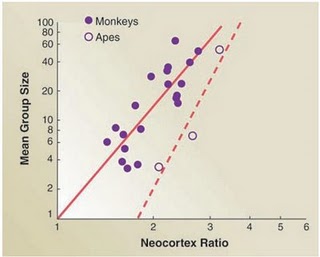
Corroborating evidence for this view comes from comparisons of brain size among primates. Firstly, there are significant positive correlations between group size and primate neocortex size (Dunbar & Shultz 2007). Secondly, there is also a positive correlation between technological innovation and tool use – which are both facilitated by social learning – on the one hand and brain size on the other (Reader and Laland 2002). Our brain, it seems, is essential a “social brain” that evolved to cope with the affordances of a primate social world that frequently got more complex (Dunbar & Shultz 2007, Lewin 2005: 220f.).

Thus, “although innovation, tool use, and technological invention may have played a crucial role in the evolution of ape and human brains, these skills were probably built upon mental computations that had their origins and foundations in social interactions” (Cheney & Seyfarth 2007: 283).

Continue reading “What Makes Humans Unique? (II): Six Candidates for What Makes Human Cognition Uniquely Human”

Bayesian Bilingualism

Recently, David Burkett and Tom Griffiths have looked at iterated learning of multiple languages from multiple teachers (Burkett & Griffiths 2010, see my post here).  Here, I’ll describe a simpler model which allows bilingualism.  I show that, counter-intuitively, bilingualism may be more stable than monolingualism.

Continue reading “Bayesian Bilingualism”

Learning Multiple languages from Multiple teachers

As Niyogi & Berwick (2009) point out, there is a tendency in modelling of Linguistic Evolution to assume chains of single learners inheriting single grammars from single teachers.   This is, of course, not realistic – we learn language from many people and people can speak more than one language.  However, Niyogi & Berwick suggest deeper objections.

Continue reading “Learning Multiple languages from Multiple teachers”

Cultural Diversity, Economic Development and Societal Instability

ResearchBlogging.orgMost of you in the science blogosphere have probably come across Razib’s recent post on linguistic diversity and poverty. The basic argument being that linguistic homogeneity is good for economic development and general prosperity. I was quite happy to let the debate unfold and limit my stance on the subject to the following few sentences I posted previously:

From the perspective of a linguist, however, I do like the idea of really obscure linguistic communities, ready and waiting to be discovered and documented. On the flip side, it is selfish of me to want these small communities to remain in a bubble, free from the very same benefits I enjoy in belonging to a modern, post-industrialised society. Our goal, then, should probably be more focused on documenting, as opposed to saving, these languages.

Since then, the debate has become a lot more heated, with Neuroanthropology wading in against Razib, which, in the second-half of the post at least, is worth reading just to get the general flavour of the other side in this debate. Having said that, I wasn’t convinced by the evidence Greg Downey used to dismiss Razib’s hypothesis, so I decided to actually look at the literature on the subject. The first paper I found upon searching was one by Nettle et al, in which they examine the relationship between cultural diversity and societal instability using a large cross-national data set of 212 nations. Importantly, they look at cultural diversity in the context of three areas: linguistically, ethnically and religious affiliation. Also, they draw a distinction between within-nation (alpha) diversity and between-nation (beta) diversity. Lastly, unlike other studies on the subject, where simple regression or correlation methods are used, the current study employs structural equation modelling (SEM):

Continue reading “Cultural Diversity, Economic Development and Societal Instability”