Just a quick note: I’m now also blogging over at Gene Expression. It’s actually pretty worthless note, considering the vast body of my visitors are equally divided between those arriving from GNXP and those using the search term Titanoboa. Still, the main point is that I’ll still be updating the site alongside my writings over at GNXP. Sadly for you Titanoboa fans I will be keeping snake-related posts to an absolute minimum.
Month: March 2010
The brain–artefact interface (BAI): a challenge for archaeology and cultural neuroscience
Just found an interesting paper on cultural neuroscience and the extended mind. Some of you might remember the author, Dr Lambros Malafouris, from Seed Magazine’s Revolutionary Minds series. I plan on providing a more thorough examination of paper at a later point. In the meantime, check out the abstract:
Cultural neuroscience provides a new approach for understanding the impact of culture on the human brain (and vice versa) opening thus new avenues for cross-disciplinary collaboration with archaeology and anthropology. Finding new meaningful and productive unit of analysis is essential for such collaboration. But what can archaeological preoccupation with material culture and long-term change contribute to this end? In this article, I introduce and discuss the notion of the brain–artefact interface (BAI) as a useful conceptual bridge between neuroplastisty and the extended mind. I argue that a key challenge for archaeology and cultural neuroscience lies in the cross-disciplinary understanding of the processes by which our plastic enculturated brains become constituted within the wider extended networks of non-biological artefacts and cultural practices that delineate the real spatial and temporal boundaries of the human cognitive map.
Some links #3
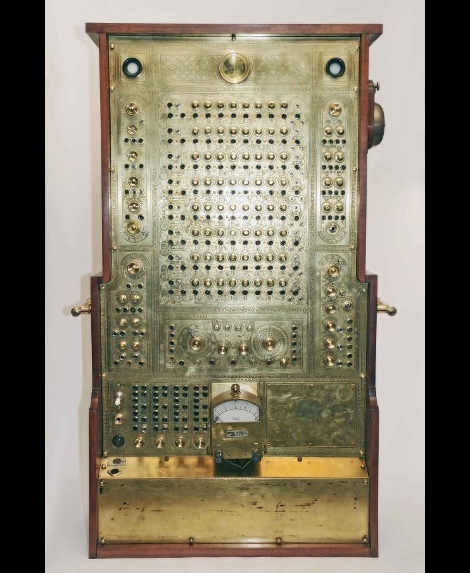
Of my random meanderings around the Internet, I think the coolest thing I’ve seen this past week certainly has to be the Steampunk sequencer:
With that out of the way, here are some links:
- In somewhat keeping with the theme from some links 2’s look at primitive writing systems, comes a post from the excellent Not Exactly Rocket Science: An 60,000-year old artistic movement recorded in Ostrich egg shells.
- More on topic of writing systems is Kevin Mitchell’s post on Why Johnny can’t read (but Jane can). Essentially, the post is asking: why dyslexia is about twice as common in boys as in girls?
- Is synaesthesia a high-level brain power? I’m not sure, but that’s the question being asked over at New Scientist.
- Science Daily claims: Simple math explains dramatic beak shape variation in Darwin’s finches. Key paragraph: “Using digitization techniques, the researchers found that 14 distinct beak shapes, that at first glance look unrelated, could be categorized into three broader, group shapes. Despite the striking variety of sizes and shapes, mathematically, the beaks within a particular group only differ by their scales.”
- Pamelia Brown has 50 Fascinating Lectures All About Your Brain. I’ve only managed to watch one of the videos (see below), so I’m certain that there is at least one fascinating lecture…
- Be sure to check out the Kahn Academy — a not-for-profit organisation that provides some great educational resources. For those of you interested in demographics and the quantitative analysis of movement, then here’s a whole section on differential equations.
- Dormivigilia provides a brief overview of a paper examining the neural origins of handedness.
- Razib Kahn over at GNXP has an in-depth discussion about the convergent evolution of skin pigmentation: OCA2 makes East Asians white and Europeans blue.
- How reliable are fMRI results? Another question I’m not so sure about. However, Prefrontal.org has a full paper on providing something of an answer. The key sentence: “the results from fMRI research may be somewhat less reliable than many researchers implicitly believe.”
- Jonah Leher has a lengthy, interesting piece over at the New York Times, asking: Is depression an adaptation? Probably not. But for a more balanced perspective, read Neurocritic’s brilliant analysis of the topic.
- Laelaps writes about a paper claiming the discovery a 4,300 year old chimpanzee nut-cracking site: Uncovering the “Chimpanzee Stone Age”.
- Lastly, Jeff Elman, UCSD professor of cognitive science and co-director of the Kavli Institute for Brain and Mind, presents a lecture on some of the latest research in our ability to use language and why it is so far removed from other animal communication systems:
Culture and the human genome: a synthesis of genetics and the human sciences
 Humans are immersed in culture from birth. It is so fundamental to our experience, and what it means to be human itself, yet we often overlook the consideration that “cultural practices might have transformed the selection pressures acting on humans” (Laland, Odling-Smee & Myles, 2010, pg. 137).
Continue reading “Culture and the human genome: a synthesis of genetics and the human sciences”