As part of my assessment this term I’m to write four mock peer-reviewed items for a module called Current Issues in Language Evolution. It’s a great module run by Simon Kirby, examining some of the best food for thought in the field. Alone this is an interesting endeavour, after all we’re right in the middle of a language evolution renaissance, however, even cooler are the lectures, where students get to do their own presentations on a particular paper. I already did my presentation at the start of this term, on Dediu and Ladd’s paper, which went rather well, even if one of my slip ups did not go unnoticed (hint: always label the graphs). So, over the next few weeks, in amongst additional posts covering some of the presentations in class, I’ll hopefully be writing articles on these four five papers:
Month: January 2009
BBC is impartial, apparently?
…Or so the news story goes:
BBC director general Mark Thompson said that if the corporation transmitted the appeal it would be “running the risk of reducing public confidence in the BBC’s impartiality in its wider coverage of the story”.
It always amuses me how the BBC retains a sense of commitment to impartiality when it continually fails to adhere to these standards on an almost daily basis. A greater irony is that through their reluctance to broadcast the Gaza Appeal, the BBC inadvertently drew the attention of Tony Benn, who decided to tell everyone the charity’s address live on BBC News (scroll down article to see the video). So now I guess the BBC’s just left with its principles…
To donate, visit: http://www.dec.org.uk (see BBC, it’s not that hard!)
ASPM, Microcephalin and Tone
 Disclaimer: I know this post is on a paper released over a year ago; however, I’m still going to write about it for three reasons: 1) I did a presentation about it earlier this week (20/01/08); 2) I think it relates to a recent buzz around gene-culture co-evolution; and, 3) It’s a bloody awesome paper.
So, what is the paper called? Okay, once you read this title, do not yawn, go to another website or… Linguistic tone is related to the population frequency of the adaptive haplogroups of the two brain size genes, ASPM and Mircocephalin. See, now we’ve got the hard part out of the way, I can begin to discuss exactly what the authors, Dan Dediu and Robert ‘Bob’ Ladd, found and why it’s important to our understanding of linguistics, genetics and evolution. It’s really interesting, honestly.
Continue reading “ASPM, Microcephalin and Tone”
Need a platform for uninformed opinions?
Then try the Guardian’s comment is free on for size. Just read Jonathan Jones’ article on religion, science and nouveau atheism. I’m not going to say much (this turns out to be a slight lie) here, other than to direct your attention to this paragraph:
[…] the Dawkins view encourages a caricature of the history of science. It dramatises a clash between scientific reason and religious superstition that is supposedly as intense today as it was in the age of Galileo. But this is a schoolchild’s version of the history of science. It is simplistic and inaccurate to imagine that scientific discovery has ever been either the fruit, or the seed, of pure reason. Science, like art, is imaginative. And the imaginative pictures of the universe created by the great scientists have rarely been free of ideas that in the nouveau atheist view are irrational.
Coffee maker, language translator and phone
Get your very own PomeGranate phone:
Sadly this clip left out it’s best feature: a built-in coffee maker:
When will it be available? 2040 is my guess.
A new philosophical stance for the BBC?
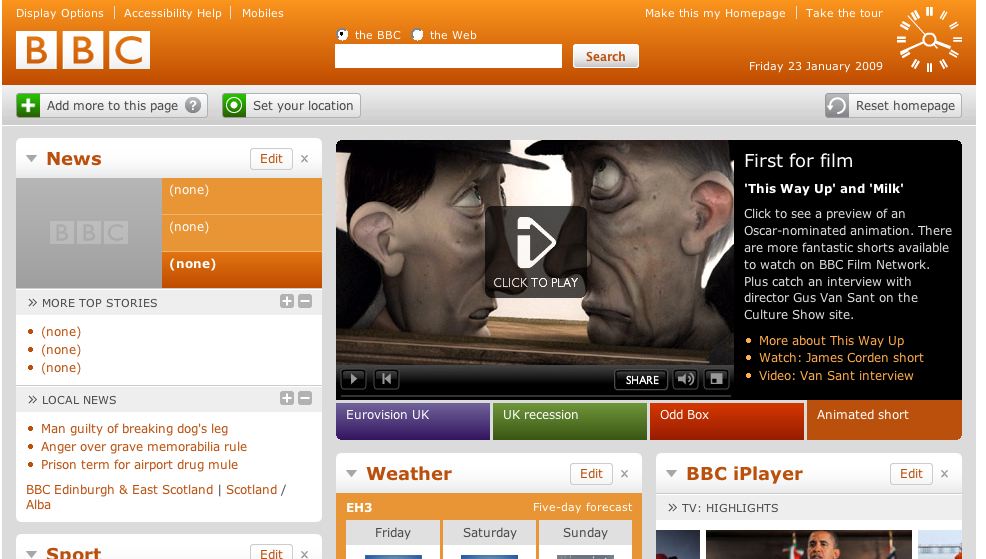
Today is no news is good news day. Honestly, see for yourself:
Swarm Intelligence
I just finished watching this great BBC documentary about swarm intelligence. Ignoring the presenter’s attempt to inspire fear in us mere humans, with ominous suggestions of a great red fire ant invasion, swarm intelligence is basically the notion that swarms of creatures (such as the aforementioned ant) work as a collective consciousness. It makes intuitive sense: more minds = more processing power. Of course, these species have been shaped by natural selection to function in this eusocial manner, although whether or not we’re discussing inclusive fitness, superorganisms or something else remains outside the programme’s scope. In fact, the term swarm intelligence doesn’t seem to be a conventional term amongst biologists; too many anthropomorphic connotations no doubt.
Sadly, it is was only available on the BBC until 21.39 GMT, today! yesterday. So get watching. Instead, I’ll leave you with the first youtube video I could find about swarm intelligence, which is actually nothing to do with animals and more to do with computing, networks and information management:
The atheist on the bus is shrill and strident…
… shrill and strident, shrill and strident. Okay, Dawkins, we get the point: atheists are accused of being shrill and strident. If you’re too lazy to click the links, then you’ll probably be a bit baffled as to what I’m ranting about. Long story short: Dawkins is getting on my nerves with his repeated use of the adjectives ‘shrill’ and ‘strident’. Nearly every piece I’ve seen him in lately involves some moment where he takes the opportunity to say these words. His latest effort being in the brilliantly devised atheist bus campaign. I mean, come on, there are plenty of other adjectives available to negatively describe atheists, with Dawkins probably knowing more than most.
Still, the master of atheism isn’t alone in his campaign of continued repetition, as AC Grayling proves when he decides to wade in with absolutely nothing new to offer. Instead, we’re treated to a completely pointless recap about there probably being no fairies etc. Moan, moan, yawn.

Ariane Sherine on the other hand, well, she’s a breath of fresh air, and I congratulate her on a successful campaign. Her positive and jovial approach to atheism is a delightful contrast to the vast numbers of Dawks (my word for the unquestioning followers of Dawkins), who seem intent on dumbing down the debate. Still, having spent the previous two paragraphs bitching, I think it’d be a bit hypocritical of me to harp on about these virtues. Let’s just hope she can spearhead some more innovative thinking in the atheist movement, much in the same vein as the aforementioned bus campaign… But next time, give Dawkins something new to say, allow more airtime for Ariane and preferably no Polly ‘New Labour cheerleader’ Toynbee.
And just to reiterate the message: There’s probably no God. Now stop worrying and enjoy your life.
More information
The official atheist bus campaign website
Negative Interest Rates
I just read this article in BBC news about negative interest rates:
If the Bank of England cuts interest rates on Thursday could the interest paid on our savings fall below zero?
Negative interest rates, where the bank charges us to look after our savings, have been seen before.
In the 1970s Swiss banks charged foreign customers rather than paying them interest to hold their money.
I don’t think we’ll see negative interest rates in the UK, although it is technically possible, and has happened before. To use the hypothetical example offered by the BBC: if you place £10,000 in the bank, and the negative interest rate is at -1%, then at the end of the year you’d get a return of just £9,900 — essentially a £100 charge for the pleasure of banking. Great.
A word of warning if this does happen: Northern Rock will, to quote one comment from the Guardian website, look like “a 6 year old emptying his piggy bank“.
Orangutans – probably more interesting than you
In the past few years there has been a recent spate of articles concerning orangutan intelligence. So, as I’m fairly bored, and in need of a break from university work, I’ve decided to write a bit of an essay on some of these finds.
Orangutans… They’re orange, right?
Correct; but Pongo pygmaeus abelii are so much more than just some arboreal orange ape that eats a lot of fruit. In fact, these great apes, the last surviving members of the genus Pongo, are highly resourceful and intelligent creatures, as evident in their ability to make and use tools, perform calculated reciprocity and even whistle a tune.
Continue reading “Orangutans – probably more interesting than you”